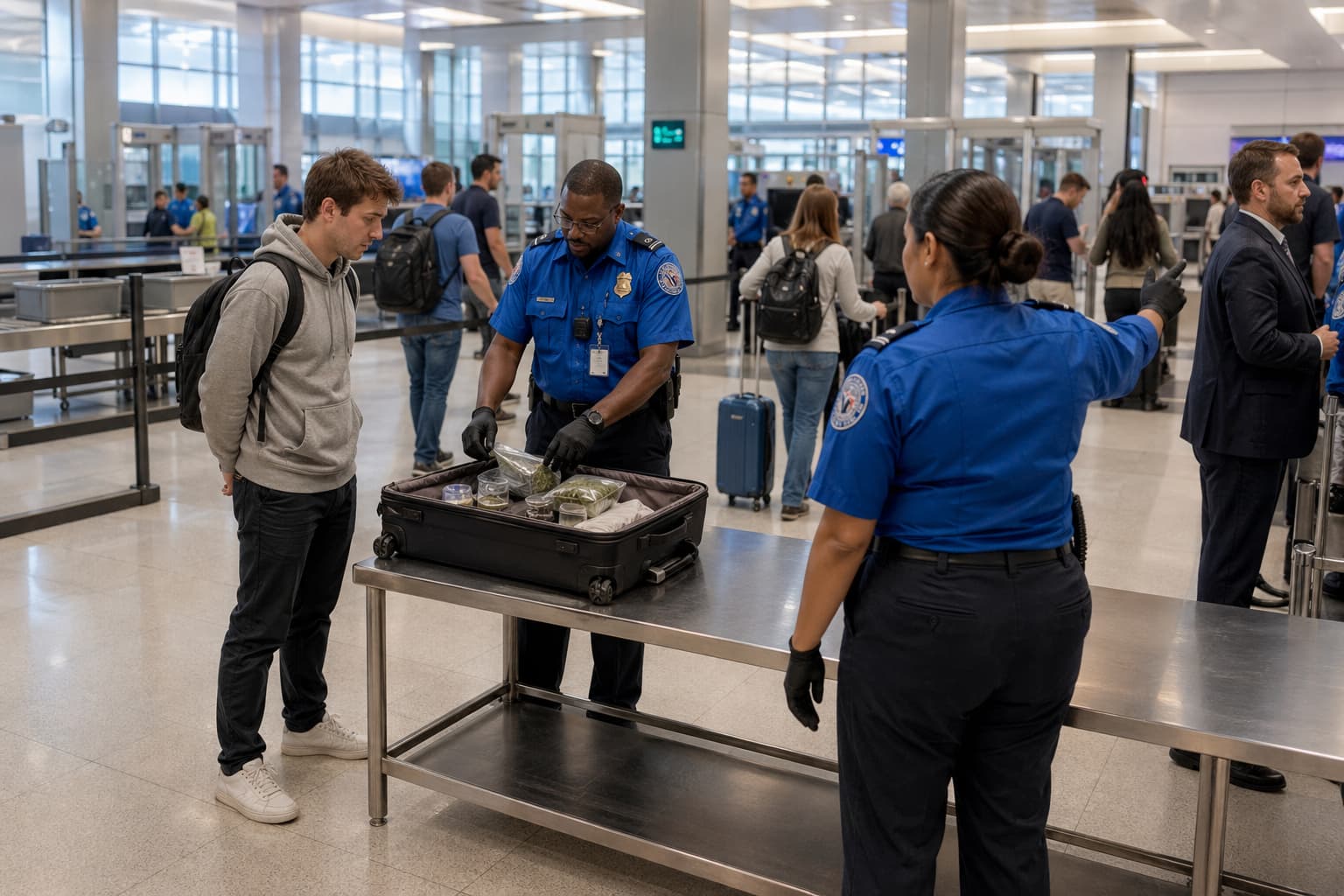
If you’re planning air travel and wondering whether you can bring marijuana with you, the answer is clear: no, you cannot legally travel on an airplane with marijuana, even if you’re flying between states where marijuana is legal. This applies to recreational marijuana, medical marijuana, edibles, vape pens, and all other cannabis products containing more than 0.3% THC.
This issue has become increasingly confusing as more states legalize marijuana for medical and recreational use. Georgia has not legalized recreational marijuana, though limited medical cannabis use is permitted under strict conditions. Regardless of state laws, federal law governs air travel, and marijuana remains illegal under federal law. With over 15 years of criminal defense experience in Atlanta, Michael Bixon has helped countless clients navigate drug possession charges, including those arrested at airports.
Understanding the intersection of federal and state marijuana laws is critical before you travel. A seemingly innocent decision to pack cannabis products in your luggage could result in criminal charges, federal prosecution, and life-altering consequences.
Federal Law Governs Air Travel
The Transportation Security Administration operates under federal jurisdiction at all airports in the United States. Under the Controlled Substances Act, marijuana remains classified as a Schedule I controlled substance at the federal level, placing it in the same category as heroin and LSD. This means that possessing marijuana, even medical marijuana with a valid state-issued card, is a federal crime when you’re on federal property, which includes airports and aircraft.
The TSA’s official policy states: “Marijuana and certain cannabis-infused products, including some Cannabidiol (CBD) oil, remain illegal under federal law except for products that contain no more than 0.3 percent THC on a dry weight basis or that are approved by the FDA.”
This federal prohibition creates a unique situation where state laws permitting marijuana use do not protect you once you enter an airport or board a plane. Even if you’re traveling from one legal state to another legal state, you’re still subject to federal law while in the airport and during your flight.
What Happens If TSA Finds Marijuana in Your Luggage?
TSA security officers are not actively searching for marijuana or other drugs. Their primary mission is to identify security threats such as weapons and explosives. However, TSA clearly states that if any illegal substance is discovered during security screening, they are required to refer the matter to law enforcement.
When TSA discovers marijuana in your carry-on or checked baggage, here’s what typically happens:
Immediate Response: The TSA officer will stop the screening process and contact local or airport police. You will be detained while officers respond.
Law Enforcement Involvement: Local police or airport police will determine how to proceed. At Hartsfield-Jackson Atlanta International Airport, the Atlanta Police Department handles these cases. Officers may issue a citation, make an arrest, or confiscate the marijuana depending on the quantity and circumstances.
Potential Charges: You could face state drug possession charges, federal drug possession charges, or both. The decision often depends on the amount of marijuana, your cooperation, whether you have prior offenses, and the jurisdiction’s enforcement policies.
Missing Your Flight: Even if you’re not arrested, the delay caused by law enforcement involvement will likely cause you to miss your flight. Airlines will not hold departures for passengers detained by police.
Atlanta attorney Michael Bixon has represented clients arrested at Atlanta’s airport for marijuana possession. These cases can be prosecuted either under Georgia state law or federal law, depending on which jurisdiction takes the case. Federal charges typically carry more severe penalties, including mandatory minimum sentences in some circumstances.
Georgia’s Marijuana Laws and How They Apply at Airports
Georgia has not legalized recreational marijuana. Possession of any amount of marijuana for recreational purposes is illegal under Georgia law. However, Georgia does allow limited use of low-THC cannabis oil for qualified patients with specific medical conditions.
Under Georgia’s medical cannabis program, patients with qualifying conditions can possess up to 20 fluid ounces of low-THC oil containing no more than 5% THC. Qualifying conditions include cancer, Crohn’s disease, mitochondrial disease, Parkinson’s disease, sickle cell disease, and several others. Patients must obtain a Low THC Oil Registry Card from the Georgia Department of Public Health.
Despite this limited medical marijuana program, Georgia patients cannot legally bring their medication to the airport or onto an airplane. Federal law preempts state law in airports, making possession illegal even with a valid Georgia medical cannabis card.
Georgia law treats marijuana possession as a misdemeanor for amounts less than one ounce. Penalties include:
- First Offense: Up to 12 months in jail and fines up to $1,000
- Subsequent Offenses: Increased penalties and potential felony charges for repeat offenders
- Possession of More Than One Ounce: Felony charges with 1-10 years imprisonment
If you’re arrested at Hartsfield-Jackson Atlanta International Airport with marijuana, you could face Georgia state charges under O.C.G.A. § 16-13-30. However, because airports are federal facilities, federal prosecution is also possible under 21 U.S.C. § 844.
Federal Charges for Marijuana Possession at Airports
Federal marijuana possession charges carry serious consequences. Under federal law, simple possession of marijuana is punishable by:
- Up to one year in federal prison
- Fines up to $1,000 for first offense
- Enhanced penalties for subsequent offenses
Federal charges are prosecuted in the United States District Court for the Northern District of Georgia if the offense occurs at Atlanta’s airport. These cases are handled by Assistant United States Attorneys, not local prosecutors. Federal court procedures differ significantly from state court procedures, with stricter sentencing guidelines and fewer diversion options.
Michael Bixon’s experience includes defending clients in both state and federal court in Georgia. Federal cases require attorneys familiar with federal rules of criminal procedure, federal sentencing guidelines, and the practices of the Northern District of Georgia.
The decision whether to prosecute federally or under state law often depends on factors including:
- Quantity of marijuana seized
- Whether other federal crimes were committed (such as interstate trafficking)
- Defendant’s criminal history
- Federal and local prosecution priorities
- Available resources and caseloads
What About CBD Products and Hemp?
Not all cannabis-related products are illegal on airplanes. The 2018 Farm Bill legalized hemp and hemp-derived products containing no more than 0.3% THC on a dry weight basis. This means that properly labeled CBD products derived from hemp are legal under federal law and permitted by TSA.
However, distinguishing legal hemp-derived CBD from illegal marijuana-derived products creates practical problems for travelers. TSA officers cannot determine THC content by visual inspection. If your CBD product is not clearly labeled, or if officers suspect it exceeds the 0.3% THC threshold, you may face additional screening or confiscation.
To travel safely with CBD products:
- Ensure products are derived from hemp, not marijuana
- Verify THC content is 0.3% or less
- Keep products in original packaging with clear labeling
- Carry documentation or certificates of analysis if available
- Be prepared to explain the product if questioned
Even with legal CBD products, Georgia law enforcement may not always distinguish between legal and illegal cannabis products. If arrested with a legal CBD product, you’ll need to prove the product meets federal requirements, which may require laboratory testing.
Real Consequences: What Happens After an Arrest
An arrest for marijuana possession at an airport triggers a series of consequences beyond the immediate criminal charges:
Bond and Release: After arrest, you’ll be taken to jail for booking. Depending on the charge and your background, you may be released on bond or required to appear before a judge for a bond hearing.
Criminal Record: A conviction creates a permanent criminal record that appears on background checks. This can affect employment, professional licensing, housing applications, and educational opportunities.
Professional Consequences: Healthcare workers, teachers, attorneys, pilots, and others with professional licenses may face disciplinary action or license suspension following a drug conviction.
Immigration Impact: Non-citizens face severe immigration consequences from drug convictions, including deportation, inadmissibility, and denial of naturalization applications.
Travel Restrictions: A federal drug conviction may restrict international travel, as many countries deny entry to individuals with drug-related criminal records.
TSA PreCheck and Global Entry: Drug convictions can result in denial or revocation of TSA PreCheck, Global Entry, and other trusted traveler programs.
Federal Consequences: If prosecuted federally, you may lose federal benefits, including student financial aid, public housing assistance, and certain federal employment opportunities.
Attorney Michael Bixon works with clients to minimize these collateral consequences through strategic defense, negotiation for reduced charges, and pursuit of alternative sentencing where appropriate.
Common Myths About Flying with Marijuana
Several dangerous myths circulate about flying with marijuana. Understanding the truth can help you avoid criminal charges:
Myth 1: “TSA doesn’t care about small amounts of marijuana.”
Truth: While TSA officers aren’t actively searching for drugs, they are required to report illegal substances to law enforcement when discovered. Personal use quantities still trigger law enforcement response.
Myth 2: “If I’m flying between two legal states, it’s fine.”
Truth: Federal law governs air travel regardless of state laws. Flying from Colorado to California with marijuana is still a federal crime.
Myth 3: “Medical marijuana card makes it legal.”
Truth: State medical marijuana cards provide no protection under federal law. Federal law does not recognize medical marijuana exceptions.
Myth 4: “Edibles and vape pens are undetectable.”
Truth: TSA x-ray equipment can identify dense organic materials. Drug-detection dogs may also be present. Packaging and labeling often make cannabis products obvious to screeners.
Myth 5: “Putting it in checked baggage avoids problems.”
Truth: Checked baggage goes through the same screening process. If marijuana is discovered, law enforcement will be contacted.
Myth 6: “TSA will just confiscate it.”
Truth: While some airports have “amnesty boxes” where you can voluntarily dispose of marijuana before security, discovery during screening results in law enforcement referral, not simple confiscation.
Airport-Specific Policies: Hartsfield-Jackson Atlanta International Airport
Hartsfield-Jackson Atlanta International Airport, the world’s busiest airport, handles these situations according to federal and Georgia law. The airport does not have a policy allowing marijuana possession, and the Atlanta Police Department enforces state marijuana laws on airport property.
If TSA discovers marijuana during screening at Atlanta’s airport:
- TSA officers stop the screening and contact the Atlanta Police Department
- APD officers respond and investigate
- Officers may arrest you for marijuana possession under Georgia law
- You may be taken to Fulton County Jail or Clayton County Jail, depending on the terminal
- Your case will be prosecuted in Fulton County State Court or Clayton County State Court
The airport does not provide amnesty or ignore marijuana possession simply because Georgia has a limited medical cannabis program. Even Georgia medical cannabis cardholders cannot legally bring their medication into the airport.
What If You’re Caught with Marijuana at the Airport?
If law enforcement confronts you about marijuana at an airport, remember these critical points:
Exercise Your Right to Remain Silent: You are not required to answer questions without an attorney present. Politely decline to answer questions and request an attorney immediately.
Do Not Consent to Searches: If officers ask permission to search your belongings beyond TSA screening, you have the right to refuse. Consenting to a search waives important legal protections.
Do Not Make Statements: Anything you say can be used against you in court. Many people inadvertently provide evidence by explaining where they got the marijuana, admitting they knew it was in their bag, or discussing how they use it.
Be Respectful: While asserting your rights, remain calm and respectful with officers. Aggressive or combative behavior will only worsen your situation.
Contact an Attorney Immediately: As soon as possible, contact a criminal defense attorney experienced with drug cases in Georgia. Early intervention can make a significant difference in your case outcome.
Do Not Miss Court Dates: If you’re released on bond, attend all required court appearances. Failure to appear results in additional charges and bond revocation.
Attorney Michael Bixon is available 24/7 for clients arrested at Atlanta’s airport or anywhere in Georgia. Immediate legal representation helps protect your rights and begin building your defense.
Defense Strategies for Airport Marijuana Possession Charges
When defending airport marijuana possession cases, several strategies may be available depending on your case’s circumstances:
Constitutional Challenges: If law enforcement exceeded the scope of TSA screening or conducted an illegal search, evidence may be suppressible under the Fourth Amendment.
Lack of Knowledge: If you did not know marijuana was in your luggage (such as if someone else packed your bag), a lack of knowing possession may be a defense.
Illegal Search and Seizure: If officers searched your belongings without probable cause or a warrant, the search may violate constitutional protections.
First Offender Treatment: Georgia’s First Offender Act may allow first-time offenders to complete probation without a conviction on their record.
Pretrial Diversion: Some jurisdictions offer diversion programs where charges are dismissed upon completion of conditions such as drug education classes and community service.
Negotiated Reduction: In many cases, an experienced attorney can negotiate for reduced charges or alternative sentencing that minimizes long-term consequences.
The best defense strategy depends on the specific facts of your case, including the amount of marijuana, your criminal history, where you were arrested, and whether federal or state prosecution is pursued.
Alternatives for Medical Marijuana Patients
If you’re a medical marijuana patient who needs medication while traveling, consider these alternatives:
Leave It at Home: The safest option is not to bring marijuana when flying. If your trip is short, plan to go without or arrange for medication at your destination if legally permitted.
Check Destination State Laws: Research whether your destination state has medical marijuana reciprocity or allows out-of-state patients to purchase medical cannabis. Some states recognize out-of-state medical cards.
Consult Your Doctor: Discuss alternative medications that are legal and safe for air travel. Your doctor may be able to prescribe legal alternatives for symptom management.
Consider CBD Products: If CBD provides therapeutic benefits, ensure you’re using hemp-derived products with less than 0.3% THC that are legal for air travel.
Drive Instead: If you must have medical marijuana, consider driving instead of flying. However, remember that transporting marijuana across state lines remains illegal under federal law, even when driving.
No medical condition, no matter how serious, provides legal protection for flying with marijuana under current federal law.
The Broader Context: Changing Laws and Ongoing Confusion
The conflict between federal and state marijuana laws creates widespread confusion for travelers. As of 2026, more than half of U.S. states have legalized marijuana for medical use, and many allow recreational use. Yet federal law continues to classify marijuana as a Schedule I controlled substance.
Recent federal policy discussions have explored marijuana rescheduling, but as of now, no changes have been implemented that would allow marijuana on airplanes. Until federal law changes, air travel with marijuana remains illegal regardless of state laws.
This patchwork of state and federal laws means that conduct that is legal in your home state becomes illegal the moment you enter an airport. Many travelers don’t realize they’re committing a federal crime until they’re confronted by law enforcement.
Some advocates hope future federal legislation will create exceptions for air travel between legal states or recognize medical marijuana cards for air travel purposes. However, no such laws currently exist, and travelers must follow existing federal restrictions.
Protect Yourself: Legal Guidance for Georgia Travelers
With more than 15 years of criminal defense experience in Atlanta, attorney Michael Bixon understands both the laws governing marijuana possession and the practical realities of airport enforcement. As a member of the Georgia Association of Criminal Defense Lawyers and the Georgia Trial Lawyers Association, and recognized among the Top 100 Trial Lawyers by the National Trial Lawyers Association, Michael Bixon has successfully defended clients facing drug charges throughout Georgia.
The key points every Georgia traveler should remember:
- Marijuana remains illegal under federal law, regardless of state legalization
- TSA must report marijuana discoveries to law enforcement
- You can face Georgia state charges or federal charges for airport marijuana possession
- Medical marijuana cards provide no federal law protection
- Even CBD products require proper labeling and THC levels below 0.3%
- An arrest creates lasting consequences beyond criminal penalties
- Early legal representation significantly impacts case outcomes
The Clear Answer for Travelers
Can you travel on an airplane with marijuana? No. The legal answer is clear, even though state marijuana laws create confusion. Federal law governs airports and air travel, making marijuana possession illegal even where state law permits it.
If you’re caught with marijuana at an airport in Georgia, you need experienced legal representation immediately. The consequences extend far beyond criminal penalties to affect your career, education, professional licenses, and future opportunities.
If you or someone you know has been charged with marijuana possession at Hartsfield-Jackson Atlanta International Airport or anywhere in Georgia, contact Bixon Law immediately for a confidential consultation. Attorney Michael Bixon provides aggressive criminal defense representation and is available 24/7 for urgent matters.
Don’t let a marijuana charge derail your future. Get experienced legal help from an attorney who knows both Georgia drug laws and federal drug prosecutions. Call Bixon Law today.