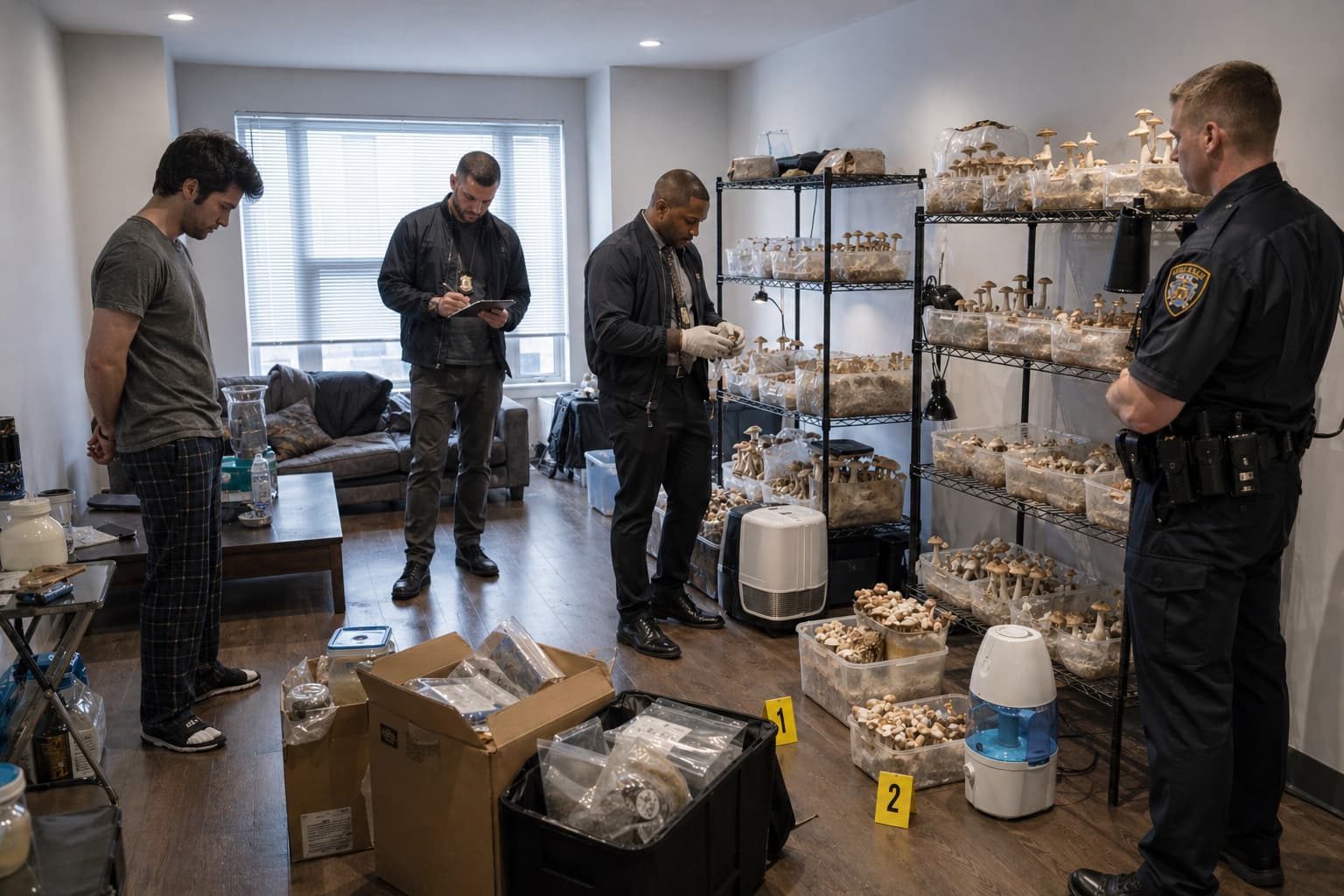
If you’re facing criminal charges for growing mushrooms containing psilocybin in Georgia, you need to understand the serious legal consequences ahead. Georgia law treats the cultivation of psilocybin mushrooms commonly called “magic mushrooms” as a felony drug offense with severe penalties, including years in prison and substantial fines.
Attorney Michael Bixon has defended countless clients throughout Atlanta facing drug cultivation and possession charges. With extensive experience handling controlled substance cases in Georgia’s criminal courts, our firm understands the complexities of defending mushroom-related charges and the stakes involved. This article explains Georgia’s laws on psilocybin mushrooms, the criminal charges you may face, potential penalties, and your defense options.
Understanding Psilocybin Under Georgia Law
Psilocybin and psilocin, the active compounds in certain species of mushrooms, are classified as Schedule I controlled substances under Georgia law. This places them in the same category as heroin, LSD, and ecstasy, meaning Georgia considers them to have high potential for abuse with no accepted medical use.
Under O.C.G.A. § 16-13-30, Georgia criminalizes the manufacture, delivery, distribution, dispensing, administration, sale, or possession with intent to distribute any controlled substance. Growing psilocybin mushrooms falls squarely under this statute’s definition of “manufacturing” a controlled substance.
The Georgia Department of Community Supervision enforces drug laws throughout the state, working closely with local law enforcement to prosecute cultivation operations. Unlike simple possession charges, cultivation charges carry the presumption that you intended to distribute the mushrooms, which dramatically increases potential penalties.
What Constitutes “Cultivation” or “Manufacturing”?
Many people arrested for growing mushrooms are surprised to learn that even small-scale personal operations can result in felony manufacturing charges. Georgia law defines manufacturing broadly to include producing, preparing, compounding, converting, or processing a controlled substance.
This means cultivation charges can arise from:
- Growing psilocybin mushrooms from spores or spawn
- Maintaining equipment used to cultivate mushrooms (grow bags, humidity chambers, substrate materials)
- Possessing mushroom spores with evidence of intent to grow (cultivation guides, growing equipment)
- Any step in the process of producing psilocybin-containing mushrooms
Even if you grew mushrooms exclusively for personal use and never sold or distributed them to anyone, prosecutors can charge you with manufacturing under Georgia law. The mere act of cultivation is sufficient.
Criminal Charges You May Face
Manufacturing a Controlled Substance
The primary charge for growing psilocybin mushrooms in Georgia is manufacturing a controlled substance under O.C.G.A. § 16-13-30(b). This is a felony offense carrying:
- Prison sentence: 1 to 10 years for a first offense
- Fines: Substantial fines may be imposed at the court’s discretion
These penalties apply regardless of the quantity of mushrooms produced or your intent in growing them. Georgia’s statute makes no distinction between small personal grows and large-scale commercial operations when determining the base felony charge.
Possession with Intent to Distribute
Even if law enforcement cannot prove you completed the cultivation process, they may charge you with possession with intent to distribute based on:
- Quantity of dried mushrooms found
- Presence of packaging materials
- Scales or measuring devices
- Large amounts of cash
- Communications suggesting sales or distribution
- Multiple locations or growing sites
This charge also falls under O.C.G.A. § 16-13-30 and carries the same 1-10 years sentencing range.
Simple Possession
If authorities find only small amounts of psilocybin mushrooms without evidence of cultivation or distribution intent, you may face simple possession charges under O.C.G.A. § 16-13-30(c). While still serious, this is typically a felony punishable by:
- Prison sentence: 1 to 10 years for a first offense
- Probation: Possible in some cases
- Fines: Substantial court costs and fees
Additional Charges Often Filed
Prosecutors frequently stack additional charges alongside cultivation offenses:
Drug-Free School Zone Violations: If your grow operation was within 1,000 feet of a school, public park, or housing project, you face enhanced penalties under O.C.G.A. § 16-13-32.4. This can add +5 years to your sentence.
Trafficking Charges: While Georgia does not have specific trafficking thresholds for psilocybin, large-scale operations may trigger trafficking prosecution with enhanced mandatory minimum sentences.
Equipment and Paraphernalia: Possession of drug-related objects under O.C.G.A. § 16-13-32.2, covering growing equipment, spore syringes, and cultivation materials.
How Law Enforcement Discovers Mushroom Growing Operations
Understanding how police typically discover cultivation operations can help you grasp the evidence prosecutors may use against you:
Search Warrants
Most mushroom grow busts result from search warrants based on:
- Tips from informants or neighbors reporting suspicious activity
- Odor complaints (some cultivation substrates produce distinctive smells)
- Utility company reports of unusual electricity or water usage
- Package interceptions (spores or growing equipment ordered online)
- Social media posts or communications intercepted through investigations
Traffic Stops and Consent Searches
Some arrests begin with routine traffic stops where officers:
- Observe mushrooms, spores, or growing supplies in plain view
- Request and receive consent to search the vehicle
- Use drug-detecting dogs that alert to the vehicle
- Discover evidence during searches incident to arrest for other offenses
Investigations of Other Crimes
Cultivation charges sometimes emerge during investigations of unrelated offenses when police execute search warrants for other crimes and discover growing operations.
Penalties and Sentencing Considerations in Georgia
Georgia judges consider numerous factors when sentencing defendants convicted of manufacturing psilocybin mushrooms. Michael Bixon’s experience defending drug cases in Fulton County Superior Court, DeKalb County courts, and throughout metro Atlanta has shown that sentences vary significantly based on case-specific factors.
First-Time Offenders
If you have no prior criminal record, you may qualify for alternative sentencing options:
First Offender Act: Under O.C.G.A. § 42-8-60, first-time offenders may plead guilty without being adjudicated guilty. Successfully completing probation results in no conviction on your record. However, this option requires court approval and is not available for all cases.
Drug Court Programs: Some Georgia jurisdictions offer drug court diversions where defendants complete intensive treatment and monitoring instead of serving prison time.
Conditional Discharge: For certain possession offenses, courts may grant conditional discharge under O.C.G.A. § 16-13-2(b), allowing for case dismissal after completing probation.
Michael Bixon works with clients to explore all possible alternatives to incarceration when available under Georgia law.
Aggravating Factors
Several circumstances can result in harsher sentences:
- Prior convictions: Previous drug offenses eliminate eligibility for most alternative sentencing programs and can result in mandatory minimum sentences
- Large quantities: Growing operations producing significant amounts of mushrooms demonstrate commercial intent
- Presence of weapons: Firearms found during cultivation bust significantly increase sentencing exposure
- Minors involved: Any involvement of persons under 18 years old triggers enhanced penalties
- Distribution to minors: Extremely serious charges with mandatory prison time
Collateral Consequences
Even if you avoid prison time, a drug manufacturing conviction carries severe collateral consequences:
Employment: Most employers conduct background checks, and a drug manufacturing conviction creates significant barriers to employment, particularly in healthcare, education, government, and positions requiring professional licenses.
Housing: Landlords frequently deny applications from individuals with drug convictions, and public housing may be unavailable.
Education: Federal student aid eligibility may be suspended or terminated following drug convictions.
Immigration: Non-citizens face deportation, inadmissibility, and denial of naturalization following controlled substance convictions.
Professional Licenses: State licensing boards may deny or revoke licenses for lawyers, doctors, nurses, teachers, and other professionals.
Firearms Rights: Felony convictions result in permanent loss of gun ownership rights under federal and Georgia law.
Legal Defenses to Mushroom Cultivation Charges
Defending against mushroom-growing charges requires a strategic approach tailored to the specific facts of your case. Michael Bixon’s aggressive defense of drug crimes has resulted in favorable outcomes for numerous clients facing cultivation charges.
Fourth Amendment Violations
Many cultivation cases involve potential constitutional violations:
Illegal Search and Warrant Issues: Police must have probable cause to obtain search warrants. If the warrant was based on insufficient information, stale intelligence, or false statements, the evidence may be suppressed.
Warrantless Searches: Searches conducted without warrants must fall within specific exceptions (consent, plain view, exigent circumstances, search incident to arrest). If police exceeded the scope of these exceptions, evidence may be inadmissible.
Standing to Challenge: You must have a reasonable expectation of privacy in the searched location to challenge the search. Homeowners, renters, and sometimes overnight guests may have standing.
Lack of Knowledge or Intent
Prosecutors must prove you knowingly cultivated psilocybin mushrooms:
No Knowledge of Contents: If you believed you were growing legal gourmet mushrooms (oyster, shiitake, etc.) and had no reason to know they contained psilocybin, you may have a viable defense.
Lack of Control: In shared residences, prosecutors must prove you knew about and controlled the growing operation. This can be challenging in houses with multiple occupants.
Insufficient Evidence of Manufacturing
Mere possession of mushroom spores is not illegal in Georgia; spores alone do not contain psilocybin. Prosecutors must prove you took steps toward cultivation:
Spore Possession Alone: Simply possessing spores without germination or growing activity may not support manufacturing charges.
Abandoned Operations: If you ceased cultivation activities long before the search, prosecutors may lack evidence of recent manufacturing.
Entrapment
If law enforcement induced you to grow mushrooms when you had no predisposition to commit the crime, entrapment may be a defense. This is rare but applicable in cases involving confidential informants who actively encourage criminal activity.
Challenging Weight and Quantity
In cases where sentencing depends on weight, the measurement methodology matters:
Moisture Content: Fresh mushrooms contain significant water weight. Prosecutors may weigh mushrooms while still wet, artificially inflating weights.
Substrate Weight: Some agencies improperly include growing substrate and contaminated materials in total weights.
Challenging these calculations can reduce sentencing exposure or trafficking charges.
The Federal vs. State Dimension
While Georgia prosecutes most mushroom growing cases, federal charges are possible under the Controlled Substances Act, 21 U.S.C. § 841. Federal prosecution typically involves:
- Large-scale commercial operations
- Interstate distribution or trafficking
- Operations on federal property
- Cases connected to ongoing federal investigations
Federal charges carry different sentencing guidelines and often more severe penalties than state charges. If federal agents were involved in your arrest, you need counsel experienced with both state and federal defense.
Recent Developments in Psilocybin Law
While psilocybin remains illegal in Georgia, national trends show changing attitudes:
Several states and cities have decriminalized psilocybin possession or created legal frameworks for therapeutic use. Oregon became the first state to legalize regulated therapeutic psilocybin. Colorado, California, and Washington have implemented or are considering similar measures.
However, Georgia has not followed this trend. State lawmakers have shown no indication of softening psilocybin penalties, and prosecution of cultivation cases continues aggressively throughout metro Atlanta and across Georgia.
Some defendants mistakenly believe that changing laws in other states provides defenses in Georgia courts. They do not. Georgia law controls, and Georgia courts have shown no leniency based on policy changes elsewhere.
What to Do If You’re Under Investigation or Arrested
If you’re facing charges or under investigation for growing psilocybin mushrooms:
Do Not Talk to Police
You have the constitutional right to remain silent. Do not make statements to law enforcement without an attorney present. Police may claim they want to “hear your side” or that cooperation will help you, but this is rarely true. Statements made during arrest often become the prosecution’s strongest evidence.
Politely decline to answer questions and clearly invoke your right to an attorney. Say: “I want to speak with my lawyer” and nothing more.
Do Not Consent to Searches
If police ask permission to search your home, vehicle, or property without a warrant, you have the right to refuse. Clearly state: “I do not consent to any searches.” This does not prevent police from searching if they have a warrant, but it preserves your Fourth Amendment rights.
Document Everything
Write down details of your arrest while they’re fresh:
- Exactly what officers said and did
- Whether you were read Miranda rights
- What you said (even if you mostly stayed silent)
- Names and badge numbers of officers
- Witnesses present
- Items seized
Preserve Evidence
Do not destroy anything related to your case. While it may seem logical to discard incriminating evidence, doing so can result in additional obstruction charges and eliminate potential defense arguments.
Contact an Experienced Criminal Defense Attorney Immediately
Time is critical in drug cultivation cases. Early attorney involvement allows for:
- Protecting your constitutional rights during questioning
- Filing motions to suppress illegally obtained evidence
- Beginning the investigation while memories are fresh
- Exploring bond and pretrial release options
- Negotiating with prosecutors before formal charges are filed
Michael Bixon has represented clients at every stage of drug crime proceedings, from initial investigations through trial and appeals. As a criminal defense attorney with deep experience in Georgia drug cases, he understands the strategies that work in Atlanta-area courts.
Why Choose Experienced Legal Representation
Drug manufacturing charges are among the most serious offenses in Georgia’s criminal code. The stakes include years of your freedom, your livelihood, and your future. You need an attorney who:
- Knows Georgia’s controlled substance statutes inside and out
- Has experience litigating search and seizure issues
- Understands forensic issues in drug cases
- Has relationships with prosecutors and judges in your jurisdiction
- Will fight aggressively to protect your rights
Public defenders often handle hundreds of cases simultaneously and may lack the time and resources to thoroughly investigate your case. Prosecutors count on defendants without experienced private counsel to accept plea deals without challenging evidence or exploring alternatives.
Attorney Michael Bixon provides aggressive criminal defense to clients throughout Atlanta and metro Georgia. With a focus on drug crimes, our firm has successfully defended clients facing cultivation, trafficking, and possession charges in Fulton County, DeKalb County, Gwinnett County, and surrounding jurisdictions.
The Investigation and Pretrial Process
Understanding what happens after arrest helps you prepare for the road ahead:
Initial Appearance and Bond
Within 48-72 hours of arrest, you’ll appear before a judge for an initial appearance. The judge will:
- Inform you of charges against you
- Determine if you’re eligible for a bond
- Set bond amount if applicable
- Appoint counsel if you cannot afford an attorney
Bond in drug manufacturing cases is often high due to the severity of charges. An experienced attorney can argue for a lower bond or release on your own recognizance based on community ties, lack of criminal history, and low flight risk.
Discovery and Investigation
Your attorney will obtain discovery from the prosecution, including:
- Police reports and arrest records
- Search warrant affidavits and returns
- Laboratory test results confirming psilocybin content
- Photographs and videos of the grow operation
- Recorded statements or interrogations
- Witness lists
Simultaneously, your defense team investigates by:
- Interviewing witnesses
- Inspecting physical evidence
- Consulting expert witnesses
- Investigating law enforcement procedures
- Identifying constitutional violations
Pretrial Motions
Strong defense cases often involve aggressive pretrial motion practice:
Motion to Suppress Evidence: Challenging illegal searches, seizures, or interrogations to exclude evidence from trial
Motion to Dismiss: Arguing insufficient evidence or legal defects in charges
Discovery Motions: Compelling prosecution to turn over Brady material (exculpatory evidence) or other information
Winning suppression motions can result in case dismissal if prosecutors lose critical evidence.
Plea Negotiations
Most criminal cases are resolved through plea agreements rather than trial. An experienced defense attorney negotiates with prosecutors to:
- Reduce charges from manufacturing to possession
- Secure recommendations for probation or alternative sentencing
- Obtain First Offender Act treatment
- Minimize sentencing exposure
Michael Bixon’s experience with Georgia drug courts and prosecutors allows him to identify weaknesses in the state’s case and leverage them during plea negotiations.
Trial Defense Strategies
If your case proceeds to trial, the prosecution must prove every element beyond a reasonable doubt:
- You knowingly manufactured or possessed with the intent to distribute psilocybin
- The substance was, in fact, psilocybin (through laboratory testing)
- You had knowledge of and control over the mushrooms or growing operation
The defense strategy depends on case facts, but may include:
- Attacking the credibility of law enforcement witnesses
- Presenting expert testimony on mushroom identification or cultivation
- Arguing lack of knowledge or intent
- Demonstrating constitutional violations to exclude evidence
- Creating a reasonable doubt about your involvement
Georgia criminal trials require unanimous jury verdicts for conviction. A single juror with a reasonable doubt results in an acquittal or a mistrial.
Protecting Your Future After a Mushroom Charge
Even if you’re convicted, options may exist to minimize long-term consequences:
Record Restriction
Georgia law allows some offenders to restrict their criminal records under O.C.G.A. § 35-3-37. While drug manufacturing convictions are typically ineligible for restriction, successful completion of First Offender Act probation can result in no conviction appearing on your record.
Appeals
If constitutional violations occurred or legal errors affected your trial, you may appeal your conviction to the Georgia Court of Appeals. Appellate work requires specialized expertise in appellate procedure and legal brief writing.
Sentence Modification
In some circumstances, Georgia law permits sentence modification after a portion of the sentence is served, particularly for defendants who demonstrate rehabilitation and low recidivism risk.
Frequently Asked Questions
- Are mushroom spores illegal in Georgia?
Mushroom spores themselves do not contain psilocybin and are technically legal to possess in Georgia. However, possessing spores along with growing equipment, cultivation guides, or other evidence of intent to manufacture can result in cultivation charges.
- What if I were growing mushrooms for personal use only?
Georgia’s manufacturing statute makes no exception for personal use. Even small-scale grows exclusively for personal consumption can result in felony manufacturing charges with the same penalties as commercial operations.
- Can police search my home based on a tip?
Police generally need a search warrant supported by probable cause to search your home. An anonymous tip alone is usually insufficient, but if police corroborate the tip with an independent investigation, they may obtain a warrant. Your attorney can challenge the warrant’s validity.
- What happens if I’m convicted of a drug felony and I’m not a U.S. citizen?
Drug manufacturing convictions are “aggravated felonies” under immigration law and trigger mandatory deportation for non-citizens, even legal permanent residents. Fighting the charges is critical to avoiding immigration consequences.
- How long does a mushroom cultivation case typically take?
Cases vary widely. Simple cases with plea agreements may resolve in 2-4 months. Complex cases involving motions to suppress, expert witnesses, and trials may take 12-18 months or longer.
- Can I travel while out on bond?
Bond conditions typically restrict travel outside the state without court permission. Violating bond conditions can result in bond revocation and jail time pending trial.
Contact an Atlanta Criminal Defense Attorney
If you’re facing charges for growing psilocybin mushrooms or any drug-related offense in Georgia, contact Bixon Law immediately. Attorney Michael Bixon provides aggressive criminal defense to clients throughout metro Atlanta and across Georgia.
We offer free consultations to review your case, explain your options, and develop a defense strategy. Early involvement of experienced counsel can make the difference between conviction and dismissal, prison and probation.
Don’t face drug manufacturing charges alone. Call Bixon Law or contact us online to schedule your free consultation. We’re available 24/7 to speak with you about your case.