If you’re facing cocaine charges in Atlanta, you need experienced legal representation immediately. At Bixon Law, criminal defense attorney Michael Bixon has over 15 years of experience defending Georgia residents against drug charges, including cocaine possession, trafficking, and distribution. Cocaine charges carry severe penalties, including lengthy prison sentences and life-altering consequences. With strategic defense and aggressive representation, we protect your rights and fight for the best possible outcome. Don’t face these charges alone. Contact us today for immediate help.
Cocaine charges in Georgia are among the most serious drug offenses prosecuted in both state and federal courts. Under Georgia law, cocaine is classified as a Schedule II controlled substance, meaning it has a high potential for abuse and severe restrictions on possession and distribution. O.C.G.A. § 16-13-30 governs cocaine offenses in Georgia and distinguishes between several types of charges based on the amount, intent, and circumstances of the alleged offense.
Possession of Cocaine
Simple possession of cocaine occurs when someone knowingly has cocaine in their possession without authorization. This is a felony offense in Georgia, regardless of the amount. Even possessing a trace amount of cocaine residue can result in criminal charges. The prosecution must prove that you knowingly and intentionally possessed the cocaine and that you were aware of its presence.
Possession with Intent to Distribute
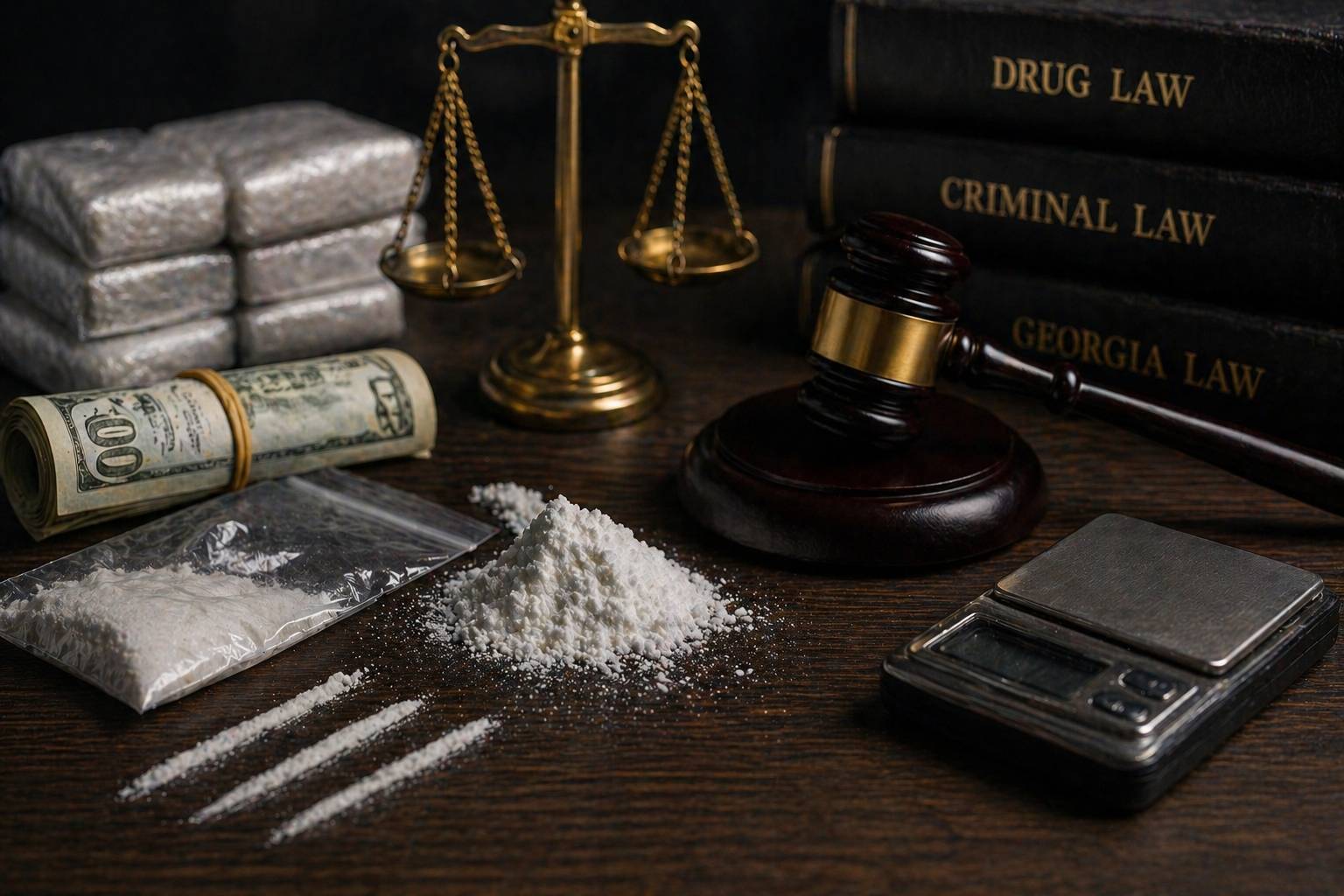
When prosecutors believe you intended to sell or distribute cocaine rather than use it personally, they will charge you with possession with intent to distribute (PWID). This more serious charge is based on factors such as the quantity of cocaine, packaging materials, scales, large amounts of cash, or text messages suggesting drug sales. PWID carries significantly harsher penalties than simple possession.
Cocaine Trafficking
Georgia law defines cocaine trafficking based solely on the weight of the substance. If you’re found with 28 grams or more of cocaine, you will automatically be charged with trafficking, regardless of whether you intended to distribute it. Trafficking charges carry mandatory minimum sentences that judges cannot reduce, making these cases particularly high-stakes.
Federal Cocaine Charges
Cocaine offenses can also be prosecuted in federal court, particularly when they involve trafficking across state lines, distribution near schools or federal property, or participation in a larger drug conspiracy. Federal cocaine charges typically carry even more severe penalties than state charges and are prosecuted by the U.S. Attorney’s Office in the Northern District of Georgia.
The consequences of a cocaine conviction in Georgia are severe and life-changing. Understanding what you’re facing is the first step in building an effective defense.
Simple Possession of Cocaine (O.C.G.A. § 16-13-30)
Possession with Intent to Distribute
Cocaine Trafficking (O.C.G.A. § 16-13-31)
Georgia’s trafficking penalties are based on the weight of cocaine:
These mandatory minimums mean that if convicted, the judge has no discretion to impose a lesser sentence, even for first-time offenders.
Federal cocaine charges under 21 U.S.C. § 841 carry even more severe consequences:
Beyond criminal penalties, a cocaine conviction affects every aspect of your life:
When you’re arrested for cocaine possession or trafficking, you have fundamental constitutional protections. Understanding and asserting these rights is critical to your defense.
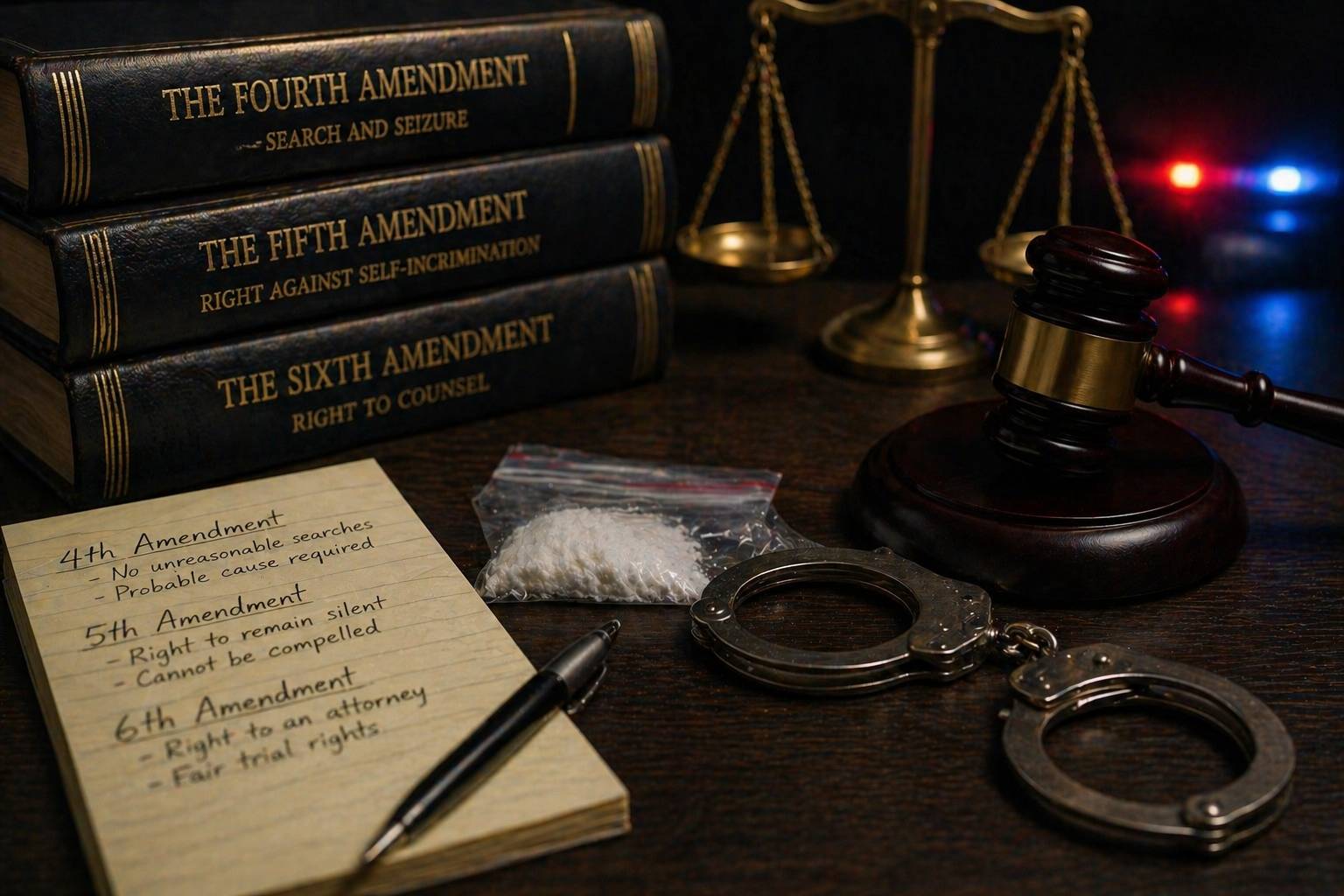
The Fourth Amendment protects you against unreasonable searches and seizures. Police must have probable cause or a valid search warrant to search your person, vehicle, or home. Common Fourth Amendment violations in cocaine cases include:
If police violated your Fourth Amendment rights, the cocaine evidence may be suppressed, potentially resulting in dismissal of all charges.
You have the right to remain silent and cannot be compelled to incriminate yourself. Anything you say to the police can and will be used against you. You should never:
Instead, politely but firmly invoke your right to remain silent and request an attorney immediately.

You have the right to legal representation at every critical stage of your case. This includes:
An experienced Atlanta cocaine defense lawyer will protect these rights and ensure that law enforcement and prosecutors follow proper procedures throughout your case.
Every cocaine case is unique, and the most effective defense strategy depends on the specific facts and evidence. At Bixon Law, we thoroughly investigate every aspect of your case to identify weaknesses in the prosecution’s evidence and constitutional violations.
The most powerful defense in many cocaine cases is suppressing illegally obtained evidence. If police violated your Fourth Amendment rights during the search that led to the cocaine discovery, we can file a motion to suppress that evidence. Without the cocaine evidence, prosecutors often cannot prove their case and must dismiss the charges.
We examine:
Michael Bixon has successfully suppressed cocaine evidence in numerous cases, resulting in complete dismissals for clients facing years in prison.
To convict you of cocaine possession, prosecutors must prove beyond a reasonable doubt that you knowingly possessed the cocaine and that you were aware it was cocaine. This is often more difficult than it seems.
We challenge possession by showing:
In many cases, particularly traffic stops with multiple occupants, we can create reasonable doubt about who possessed the cocaine.
In trafficking cases, the weight of the cocaine is critical because it determines whether you face mandatory minimum sentences. We carefully scrutinize:
Even small reductions in weight can mean the difference between a mandatory 10-year sentence and a lesser charge with no mandatory minimum.
Understanding what to expect can reduce anxiety and help you make informed decisions throughout your case.
After a cocaine arrest, you’ll be taken to the county jail for booking. This includes fingerprinting, photographing, and background checks. You’ll be held until you see a judge for a bond hearing, typically within 48 to 72 hours.
What Michael Bixon Does: We work to arrange bond as quickly as possible and prepare arguments for your bond hearing to secure your release.
At your bond hearing (also called first appearance), a judge will decide whether to release you on bond and set any conditions. Factors include the severity of the charge, your criminal history, ties to the community, and flight risk.
What Michael Bixon Does: We present evidence of your community ties, employment, family connections, and lack of flight risk. For serious trafficking charges, bond may be denied initially, but we can file a bond motion later.
Once retained, we immediately begin investigating your case. This includes:
Timeline: 2 to 6 weeks
At arraignment, you’ll be formally advised of the charges against you and enter a plea of guilty, not guilty, or no contest. We always advise entering a not guilty plea at this stage to preserve all your options.
What Michael Bixon Does: We appear with you at arraignment, enter your not guilty plea, and begin discovery negotiations with the prosecutor.
Based on our investigation, we file motions to suppress evidence, dismiss charges, or compel discovery. The motion to suppress hearing is one of the most critical stages in cocaine cases. If successful, it can result in the dismissal of all charges.
What Michael Bixon Does: We prepare detailed legal briefs, cross-examine police officers, and present evidence of constitutional violations. Michael’s experience as a criminal defense attorney gives him deep insight into police procedures and how to expose their mistakes.
Timeline: 2 to 6 months after arraignment
Throughout the case, we engage in ongoing negotiations with prosecutors. Even as we prepare for trial, we’re working to secure the most favorable plea offer possible, whether that’s reduced charges, lighter sentences, or entry into diversion programs.
What Michael Bixon Does: We leverage weaknesses in the prosecution’s case to negotiate from a position of strength. We never recommend accepting a plea unless it’s in your best interest.
If we cannot reach an acceptable plea agreement, we will take your case to trial. In Georgia, you have the right to a jury trial for felony cocaine charges. We meticulously prepare by:
Timeline: Trials typically occur 6 to 18 months after arrest for state charges, 12 to 24 months for federal charges.
If you’re convicted at trial or accept a plea agreement, the judge will impose a sentence. We present mitigation evidence to secure the lightest possible sentence, including:
What Michael Bixon Does: We fight for alternatives to incarceration, including probation, house arrest, or treatment programs whenever possible.
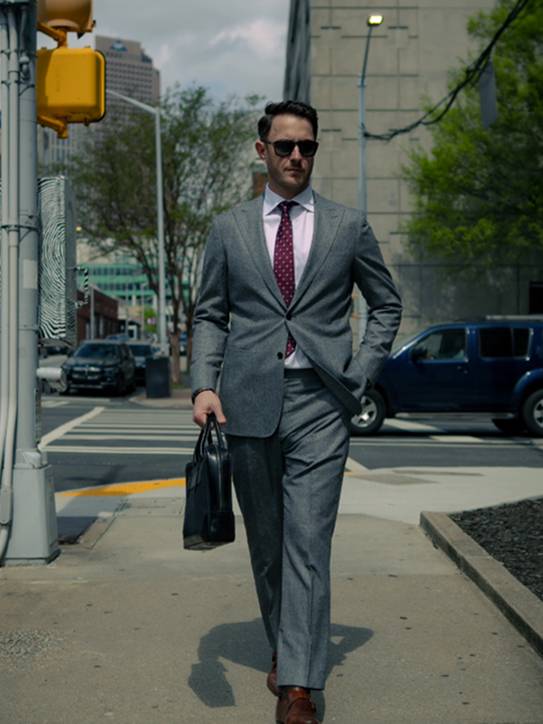
Michael Bixon regularly defends cocaine cases in:
When you’re facing years in prison and life-altering consequences, you need an attorney with the experience, skills, and dedication to fight for you.
Michael Bixon founded Bixon Law in 2011 and has devoted his entire legal career to criminal defense. He has handled hundreds of drug cases, from simple possession to large-scale federal trafficking conspiracies. This depth of experience means he understands exactly how prosecutors build their cases and how to dismantle them.
Michael Bixon has secured favorable outcomes for clients facing cocaine charges, including:
While past results do not guarantee future outcomes, Michael’s track record demonstrates his commitment and ability to achieve the best possible results.
Many criminal defense attorneys avoid going to trial. Michael Bixon is not one of them. He is a graduate of the prestigious Bill Daniel Trial Program and is recognized by the National Trial Lawyers Association as a Top 100 Trial Lawyer. When your case needs to go before a jury, you want an attorney who has been in the courtroom and knows how to win.
Michael regularly appears in Fulton, DeKalb, Gwinnett, Cobb, and Clayton County courts. He knows the judges, prosecutors, and court procedures. This familiarity is invaluable when negotiating plea agreements or preparing for trial because he understands how each court operates and what arguments resonate with each judge.
If you’re facing federal cocaine charges, you need an attorney admitted to practice in federal court and experienced with federal procedures. Michael Bixon is admitted to the U.S. District Court for the Northern District of Georgia and has successfully defended clients against federal drug trafficking and conspiracy charges.
At Bixon Law, you’re not just a case number. Michael personally handles every case and is directly accessible to his clients. You’ll have his cell phone number, and he’ll return your calls promptly. He understands the stress and fear you’re experiencing and is committed to guiding you through this process with compassion and clear communication.
Drug arrests often happen late at night or on weekends. Michael Bixon makes himself available 24/7 for urgent matters, including bond hearings and jail release. When you need immediate legal help, Bixon Law is there.
Michael is an active member of:
These memberships reflect his commitment to staying current with changes in criminal law, learning from the best defense attorneys in the country, and providing the highest quality representation.
Beyond criminal defense, Michael volunteers with the Atlanta Volunteer Lawyer Foundation, providing pro bono legal services to those in need in housing and debt matters. His commitment to justice extends beyond the courtroom.
Contact us now for a free consultation
Whether you face jail time depends on several factors: the amount of cocaine, whether you have prior convictions, whether you’re charged with simple possession or trafficking, and the strength of the prosecution’s evidence. First-time offenders charged with simple possession may be eligible for probation, pre-trial diversion, or drug court programs that avoid jail time entirely. However, trafficking charges carry mandatory minimum prison sentences. An experienced Atlanta cocaine defense lawyer can evaluate your case and advise you on the most likely outcomes.
Legal fees for cocaine defense vary depending on the complexity of the case, whether it’s charged in state or federal court, and whether the case goes to trial. Simple possession cases generally cost less than trafficking or conspiracy cases. At Bixon Law, we offer free initial consultations where we’ll discuss your case and provide a clear fee structure. We also offer flexible payment plans to make quality legal representation accessible. The cost of an experienced attorney is an investment in your freedom and future.
Yes. Cocaine charges can be dismissed for several reasons:
Michael Bixon has obtained dismissals in numerous cocaine cases by identifying and exploiting weaknesses in the prosecution’s case.
State cocaine charges are prosecuted by the district attorney in Georgia state court. Federal charges are prosecuted by the U.S. Attorney’s Office in federal court. Federal charges typically involve:
Federal penalties are generally more severe, with longer mandatory minimums and no parole. Federal cases also involve different procedures, including federal sentencing guidelines.
Georgia offers several alternatives to incarceration for drug offenders, particularly first-time offenders:
Eligibility depends on your charges, criminal history, and the county where you’re prosecuted. Michael Bixon has helped many clients avoid jail through these programs.
Do not consent to searches. Politely but firmly say, “I do not consent to searches.” If police have a warrant, do not resist, but do not answer questions without your attorney present. If police search without your consent or a warrant, that may be grounds to suppress the evidence. Call Michael Bixon immediately after any search or arrest.
State cases typically resolve within 6 to 18 months, depending on whether you go to trial. Federal cases take longer, usually 12 to 24 months. Simple possession cases with plea agreements may resolve in as little as 3 to 6 months. The timeline depends on:
Michael Bixon works efficiently to resolve cases as quickly as possible while never rushing to a bad outcome.
Yes. Cocaine convictions are considered “aggravated felonies” under immigration law and can result in:
If you’re not a U.S. citizen, it’s critical to hire an attorney who understands the immigration consequences of criminal convictions. Michael Bixon works with immigration attorneys to minimize or eliminate immigration consequences whenever possible.

If you’ve been charged with cocaine possession, distribution, or trafficking in Atlanta or anywhere in Georgia, every moment counts. The decisions you make now will affect the rest of your life. Don’t risk your freedom, your career, and your future by facing these charges alone or with inexperienced representation.
At Bixon Law, we provide aggressive, strategic defense for clients facing cocaine charges in state and federal court. We’re available 24/7 to discuss your case, answer your questions, and begin building your defense immediately.
Call us today for a free, confidential consultation.
When you call, you’ll speak directly with Michael Bixon, not a paralegal or intake specialist. He’ll listen to your situation, explain your options, and outline a strategic plan for your defense.
Don’t wait. The sooner we begin investigating your case, the better your chances of a favorable outcome. Contact Bixon Law now. We’re here to fight for you.