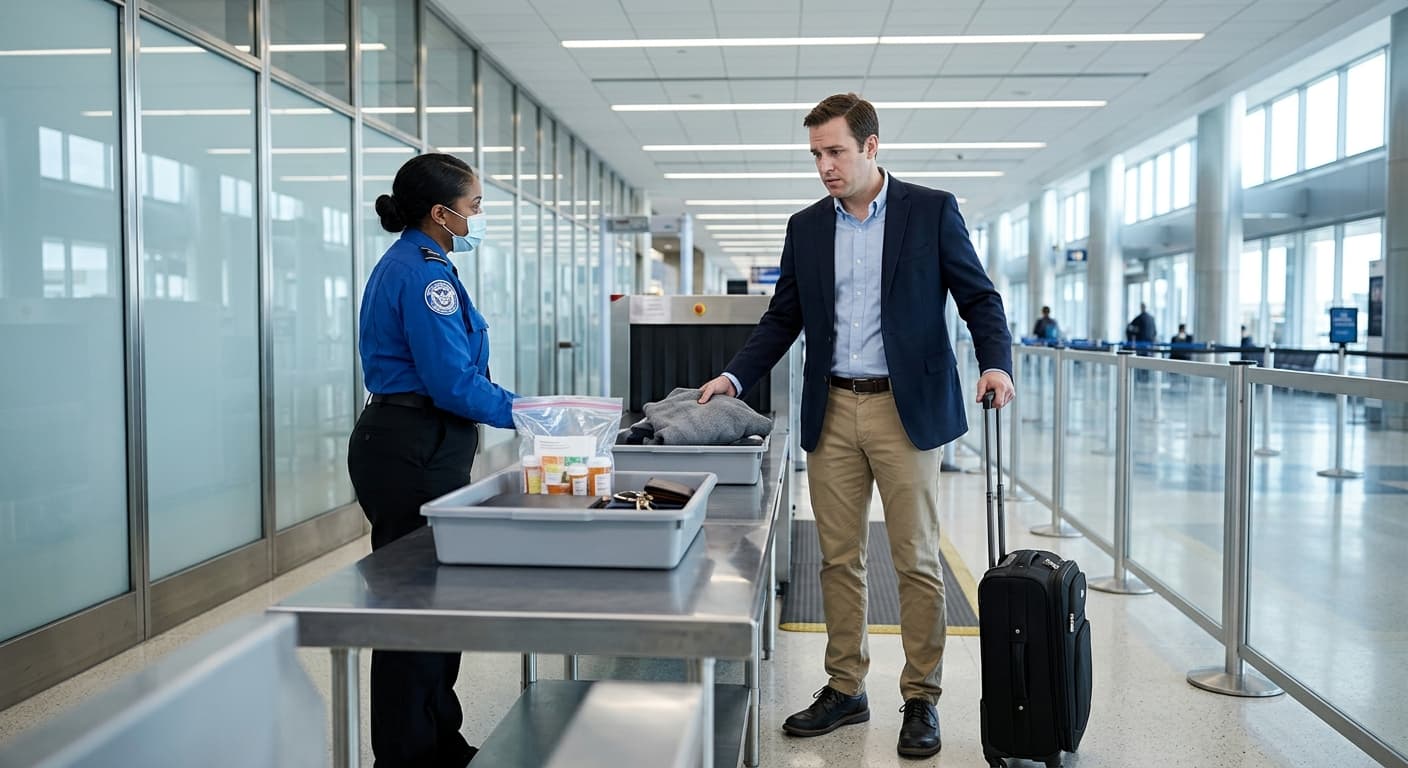
The Anxiety of Traveling Through Hartsfield-Jackson Atlanta International Airport with Medicinal Cannabis Products
Standing in the security line at Hartsfield-Jackson Atlanta International Airport, Georgia’s Low-THC Registry Card in your wallet, you’re wondering whether TSA agents are about to turn your travel plans into a criminal nightmare. The anxiety is real, and it’s justified. Medical marijuana laws exist in a confusing legal gray area when you’re preparing to board a flight, and understanding how federal TSA regulations interact with Georgia’s limited cannabis laws can mean the difference between making your flight and facing arrest.
For Georgia residents who legally possess low-THC cannabis oil under state law, air travel creates a unique legal dilemma. You’re complying with Georgia regulations, but the moment you step into an airport, you’re entering federal jurisdiction where cannabis, regardless of THC content, remains a Schedule I controlled substance. The Transportation Security Administration (TSA) operates under federal authority, and its screeners work in an environment governed by federal law, not state medical marijuana programs.
Michael Bixon has defended countless individuals facing drug charges in Georgia, including cases that began with airport detentions. The confusion surrounding TSA policies and Georgia’s cannabis laws leads many travelers to make decisions that can result in criminal charges, missed flights, and permanent criminal records. Understanding what actually happens when TSA discovers cannabis products during screening is essential for anyone considering traveling with medical marijuana through Atlanta’s airports.
This article clarifies the current TSA stance on medical marijuana, explains how federal aviation security intersects with Georgia’s Low-THC Oil Registry program, and details exactly what occurs when Atlanta law enforcement gets involved. Whether you’re a Georgia cardholder or an out-of-state medical marijuana patient connecting through Atlanta, knowing your legal exposure before you reach the checkpoint is critical.
Current TSA Federal Rules: Understanding that TSA is a Federal Agency Governed by Federal Law, Where Marijuana (Above 0.3% THC) Remains Technically Illegal
The Transportation Security Administration operates exclusively under federal authority as a component of the Department of Homeland Security. This federal jurisdiction means TSA policies reflect federal law, and under federal law, marijuana remains classified as a Schedule I controlled substance under the Controlled Substances Act, regardless of state-level legalization or medical programs.
Federal Cannabis Classification
The federal government categorizes marijuana alongside heroin, LSD, and ecstasy as substances with “no currently accepted medical use and a high potential for abuse.” This classification persists despite dozens of states implementing medical or recreational cannabis programs. When you enter airport security, you’re not subject to Georgia law; you’re subject to federal regulations that make no distinction between medical and recreational cannabis, or between different THC concentrations above the federally permitted 0.3% threshold.
The Hemp Exception Under Federal Law
Federal law does recognize one narrow exception: hemp-derived products containing no more than 0.3% delta-9 THC. The 2018 Farm Bill legalized hemp and hemp-derived products at the federal level, creating a legal pathway for CBD products that meet this strict THC limitation. TSA’s official policy acknowledges this federal hemp exception, stating that products containing hemp-derived CBD with less than 0.3% THC are permissible in carry-on and checked bags.
However, Georgia’s Low-THC Registry Card authorizes possession of cannabis oil containing up to 5% THC, significantly higher than the federal hemp threshold. This discrepancy creates the core legal conflict for Georgia medical cannabis patients attempting air travel.
TSA’s Official Stated Policy on Marijuana
According to TSA’s website, updated as recently as 2026, the agency’s screening procedures are “focused on security and are designed to detect potential threats to aviation and passengers.” The TSA explicitly states: “Accordingly, TSA security officers do not search for marijuana or other illegal drugs, but if any illegal substance is discovered during security screening, TSA will refer the matter to a law enforcement officer.”
This policy language is carefully crafted. TSA doesn’t actively hunt for cannabis, but screeners are legally required to report it when discovered. The practical effect is that while TSA won’t prioritize finding your cannabis products, you’re not free to travel with them without legal risk.
Medical Marijuana Cards Provide No Federal Protection
Carrying a medical marijuana card from any state or Georgia’s Low-THC Registry Card provides zero legal protection under federal law or TSA regulations. Federal law does not recognize state medical cannabis programs. Your Georgia authorization to possess low-THC oil is a state law permission that has no effect in federal spaces like airports, airplanes, or during TSA screening.
Out-of-state medical marijuana cards face the same limitation. A California, Colorado, or Florida medical marijuana card holds no legal weight with TSA or federal law enforcement. From the federal perspective, all marijuana possession remains illegal regardless of state medical authorizations.
Cannabis Products That Fall Under Federal Scrutiny
TSA’s marijuana policy applies to all cannabis products containing more than 0.3% THC:
- Cannabis flower or buds: Always illegal under federal law
- Vape cartridges and pens: Illegal if they contain cannabis-derived THC above 0.3%
- Edibles (gummies, chocolates, baked goods): Illegal if they contain THC above the federal threshold
- Cannabis oils and tinctures: Illegal if THC content exceeds 0.3%, including Georgia’s legal low-THC oil (up to 5% THC)
- Concentrates (wax, shatter, dabs): Federally illegal
- Topicals: Illegal if THC content exceeds federal limits
TSA screeners cannot and do not perform chemical analysis to determine THC content on-site. If a product appears to be a cannabis derivative, or if packaging indicates marijuana content, screeners will likely treat it as a potential violation and refer it to law enforcement for determination.
What About CBD Products?
Pure CBD products derived from hemp and containing less than 0.3% THC are federally legal and permissible through TSA screening. However, travelers should be prepared to demonstrate that their CBD products meet federal requirements. Products with clear labeling indicating hemp-derived CBD and THC content below 0.3% are far less likely to generate concerns.
The challenge is that many CBD products available in Georgia may not have adequate labeling or may contain THC levels that exceed federal limits. Georgia dispensaries authorized to distribute low-THC oil specifically serve products with up to 5% THC, which remain federally illegal and subject to TSA referral.
Federal Consistency Regardless of Departure or Arrival State
TSA policies apply uniformly regardless of whether you’re flying from Georgia to California (both states with cannabis programs) or from Georgia to Texas (where cannabis remains largely illegal). The departure state’s marijuana laws, the arrival state’s marijuana laws, and any states you fly over are all irrelevant to federal TSA policy. Federal law governs in all U.S. airports, period.
Prescription Medications vs. Medical Marijuana
It’s critical to understand that medical marijuana is not treated like prescription medications by TSA or federal authorities. Lawful prescription medications, even controlled substances like opioids or benzodiazepines prescribed by a physician, are permissible through TSA screening when properly labeled and prescribed to the traveler. Medical marijuana does not receive this treatment because it is not federally recognized as a legitimate prescription medication.
Physicians in medical marijuana states don’t write “prescriptions” for cannabis; they provide recommendations or certifications because cannabis cannot be prescribed under federal law. This distinction matters when you’re trying to explain to a TSA agent or police officer why you’re carrying cannabis products.
TSA’s Primary Mission: Explaining that TSA Screeners Look for Safety/Weapon Threats, Not Drugs, but Are Legally Obligated to Report Discovered Substances to Local Police
Understanding TSA’s mission and priorities helps clarify why their marijuana policy functions the way it does. TSA screeners aren’t drug enforcement officers, and their training focuses primarily on identifying security threats, such as weapons, explosives, and other items that could endanger aircraft or passengers.
Security Screening, Not Drug Enforcement
TSA’s founding purpose following the September 11, 2001 attacks was preventing terrorism and protecting the safety of air travel. Screeners receive extensive training on identifying firearms, knives, explosive materials, and other security threats. Drug detection is not their primary objective, and TSA agents are not trained as narcotics officers.
This is why TSA’s official guidance states they don’t search for marijuana. Their screening protocols prioritize aviation security. When an agent is examining your bag on the x-ray monitor or conducting a physical inspection, they’re looking for weapons and explosives, not small quantities of cannabis.
Incidental Discovery During Routine Screening
Cannabis products are typically discovered incidentally during routine security screening. An agent may notice something suspicious on the x-ray screen, perhaps a dense object, unusual organic material, or items that require closer inspection for security purposes. During that secondary screening, cannabis products may become apparent.
Common scenarios where cannabis is discovered:
- Vape pens and cartridges: These often trigger additional screening because of their electronic components and liquid contents, both of which require inspection for aviation safety
- Edibles in packaging: Unusual food items or packaging that obscures contents may prompt bag searches
- Odor: Strong cannabis odor emanating from bags will attract screener attention
- Oils and liquids: Any liquids trigger TSA’s 3-1-1 rule for carry-ons, requiring separate screening
- Grinders or paraphernalia: These metal objects appear clearly on x-rays and may prompt inspection
The Legal Obligation to Report
Even though finding drugs isn’t TSA’s mission, federal regulations require TSA agents to report suspected violations of federal law to law enforcement. This isn’t discretionary. When a TSA screener identifies what appears to be marijuana or other illegal drugs, they are legally obligated to contact airport law enforcement.
This mandatory reporting requirement means that even sympathetic or indifferent TSA agents cannot simply ignore discovered cannabis. The screener must notify local or airport police. What happens after that notification depends entirely on local law enforcement policies, not TSA.
TSA Agents Are Not Making Arrests
TSA screeners themselves have no arrest authority. They are not law enforcement officers. If they discover cannabis during screening, they notify law enforcement and step back. The TSA agent’s role ends at notification. Whether you face arrest, citation, confiscation, or just a warning depends on the responding police officers and the policies of that specific airport’s law enforcement agency.
The Role of Local and Airport Police
Once TSA refers a cannabis discovery to law enforcement, airport police, or local police agencies take over. At Hartsfield-Jackson Atlanta International Airport, this typically means the Atlanta Police Department, which has jurisdiction over the airport. The responding officer will assess the situation, determine what substances are involved, verify quantities, and decide on enforcement action.
This handoff from TSA to local police is where state and local policies begin to matter again. While TSA operates under federal rules, local police agencies may have their own departmental policies about marijuana enforcement, particularly for small amounts or medical marijuana cardholders.
Discretion at the Local Level
Local police officers responding to TSA referrals have some degree of discretion in how they handle marijuana discoveries. In jurisdictions where marijuana is decriminalized or deprioritized, officers may choose to confiscate cannabis without making arrests for small personal amounts. In more conservative jurisdictions or where department policy mandates enforcement, arrests may follow.
Michael Bixon has represented clients who faced dramatically different outcomes for similar TSA cannabis discoveries depending on which airport they were traveling through and which law enforcement agency responded. The lack of uniform enforcement creates unpredictability.
Factors That Influence Law Enforcement Response
Several factors influence whether airport police will arrest, cite, or simply confiscate:
- Quantity: Small personal-use amounts are treated differently than large quantities, suggesting distribution
- Product type: Flower vs. edibles vs. concentrates may influence officer perception
- Traveler cooperation: Honest, respectful communication vs. deception or resistance
- Medical documentation: Possession of a valid state medical card or Low-THC Registry Card (though legally insufficient, may influence officer discretion)
- Local enforcement priorities: Some jurisdictions deprioritize marijuana enforcement generally
- Destination: Officers may consider whether the traveler is departing from or arriving at their home jurisdiction
TSA’s Non-Enforcement Posture vs. Legal Reality
The gap between TSA’s stated non-priority approach to marijuana and the legal obligation to report creates a confusing environment. TSA emphasizes they’re not looking for drugs, which some travelers interpret as permission. But the reality is that discovery still triggers law enforcement involvement, and travelers can still face criminal consequences.
This is not a “don’t ask, don’t tell” policy. It’s a “we’re not looking, but if we find it, we must report it” policy, a significant distinction that travelers must understand before deciding to bring cannabis products through airport security.
What Happens at Atlanta Airports: How the Atlanta Police Department Handles Out-of-State Medical Cards and Local Possession Laws When Called by TSA
Hartsfield-Jackson Atlanta International Airport is one of the busiest airports in the world, processing over 100 million passengers annually. The Atlanta Police Department maintains a significant presence at the airport and responds to TSA referrals involving suspected controlled substances. Understanding how Atlanta police handle these situations, particularly for medical marijuana cardholders, is essential for anyone considering traveling through ATL with cannabis products.
Atlanta Police Department’s Jurisdiction and Policies
The Atlanta Police Department has primary law enforcement jurisdiction at Hartsfield-Jackson. When TSA discovers suspected marijuana and notifies law enforcement, Atlanta PD officers respond and make enforcement decisions based on Georgia law, department policy, and officer discretion.
Georgia law enforcement agencies, including Atlanta PD, enforce state law, not federal law. This creates an important distinction. While TSA operates under federal regulations where all marijuana is illegal, Atlanta police enforce Georgia’s criminal code, which treats certain cannabis offenses differently.
Georgia’s Criminal Marijuana Laws
Under Georgia law, marijuana possession (outside the Low-THC Registry program) remains a criminal offense:
- Less than one ounce: Misdemeanor, punishable by up to 12 months in jail and fines up to $1,000 (O.C.G.A. § 16-13-30(j))
- One ounce or more: Felony possession, with escalating penalties based on quantity
However, Georgia has decriminalized possession of less than one ounce in certain municipalities, including the City of Atlanta. In 2017, the Atlanta City Council passed an ordinance allowing officers to issue civil citations (rather than criminal arrests) for possession of one ounce or less of marijuana. This ordinance gives Atlanta police officers discretion to issue $75 civil fines instead of making criminal arrests for small amounts.
How Atlanta Police Typically Respond to TSA Referrals
When called to a TSA checkpoint for marijuana discovery, Atlanta PD officers will:
- Assess the substance and quantity: Officers will examine what was discovered, determine if it appears to be marijuana or a marijuana product, and estimate quantity.
- Interview the traveler: Officers will ask about ownership, intended use, and whether the traveler possesses any medical documentation.
- Determine enforcement action: Based on the substance, quantity, and circumstances, officers decide whether to:
- Confiscate the substance and release the traveler with no charges
- Issue a civil citation (for less than one ounce under Atlanta’s ordinance)
- Make a criminal arrest (for larger amounts, concentrates, or at officer discretion)
Out-of-State Medical Marijuana Cards at Atlanta Airport
Georgia does not recognize out-of-state medical marijuana cards. If you’re traveling through Atlanta with a California, Colorado, Florida, or other state’s medical marijuana card, that documentation provides no legal defense under Georgia law.
Atlanta police officers may consider an out-of-state medical card as a mitigating factor when deciding whether to exercise discretion, but it does not prevent arrest or citation. You are not legally authorized to possess marijuana in Georgia based on another state’s medical program.
Michael Bixon has represented numerous out-of-state travelers arrested at Hartsfield-Jackson after TSA discovered cannabis products they were legally authorized to possess in their home states. These cases often involve travelers who assumed their medical cards would protect them or who didn’t realize Georgia doesn’t have reciprocity with other states’ programs.
Georgia Low-THC Registry Cards at the Airport
Georgia residents with valid Low-THC Registry Cards are legally authorized under state law to possess up to 20 fluid ounces of low-THC oil containing no more than 5% THC (O.C.G.A. § 16-12-191). This is a legitimate state law authorization that Atlanta police officers are aware of and generally respect.
However, several critical limitations apply:
- Federal property limitations: The Low-THC Registry Card is a Georgia state law authorization. It does not provide protection on federal property or under federal law. Airports involve federal jurisdiction, creating legal ambiguity about whether state authorization applies.
- Product verification: Officers may question whether the product you possess is actually compliant low-THC oil (5% THC or less) or illegal marijuana. Without laboratory testing at the airport, this determination can be difficult.
- Packaging and labeling: Low-THC oil obtained from Georgia’s authorized dispensaries typically comes with proper labeling indicating THC content and the dispensary source. Home-packaged or unlabeled products will raise officer suspicion about legality.
- Possession limits: The registry card authorizes possession of low-THC oil specifically, not marijuana flower, high-THC concentrates, or other cannabis products.
If you present a valid Georgia Low-THC Registry Card to Atlanta police after a TSA referral, and you possess properly labeled low-THC oil in compliant amounts, officers may determine no state law violation occurred and allow you to proceed. However, this is not guaranteed, and officers may still confiscate the product based on federal airport regulations or department policy.
The Reality: Confiscation is Common Regardless of Cards
Even when travelers possess medical documentation, whether Georgia Low-THC cards or out-of-state medical cards, Atlanta police frequently confiscate cannabis products at the airport without returning them, even if no arrest is made. The reasoning is that allowing cannabis products onto an aircraft violates federal law, and officers won’t facilitate that violation even if state law might permit possession outside the airport.
Practically, this means:
- You may avoid arrest or criminal charges
- You will lose your cannabis products
- You may miss your flight due to the delay
- You could still face a civil citation or warning
Factors That Influence Atlanta Police Officer Discretion
Atlanta police officers handling TSA marijuana referrals consider multiple factors:
- Quantity: Small personal amounts (under one ounce) are more likely to result in citation or confiscation rather than arrest
- Product type: Flower is treated differently than concentrates or large quantities of edibles
- Traveler’s residency: Georgia residents with Low-THC cards may receive more favorable treatment than out-of-state travelers with no Georgia ties
- Honesty and cooperation: Travelers who are respectful, honest, and cooperative typically fare better than those who lie or become confrontational
- Prior criminal history: Officers may check for warrants or prior drug offenses, which can influence their decision
- Traveler’s demeanor and credibility: Medical explanations that seem legitimate vs. recreational use denials
Consequences Beyond Criminal Charges
Even if Atlanta police don’t arrest you, a TSA marijuana incident can trigger consequences:
- Missed flights: The detention and investigation process can cause you to miss your scheduled departure
- TSA documentation: TSA may document the incident, potentially affecting future TSA PreCheck eligibility or enhanced screening
- Civil penalties: Even without criminal charges, you may receive civil citations or fines
- Professional consequences: If you’re required to report law enforcement contacts for professional licensing, even non-arrest incidents may need disclosure
Michael Bixon’s Experience with Airport Drug Cases
As an experienced criminal defense attorney in Atlanta, Michael Bixon has defended numerous individuals facing drug cases that originated at Hartsfield-Jackson. These cases demonstrate the wide range of outcomes that can occur:
- Some clients faced felony trafficking charges for larger quantities or concentrates discovered during airport screening
- Others received misdemeanor possession charges despite possessing medical cards from other states
- Many had their cannabis confiscated but avoided criminal charges due to small amounts and medical documentation
- Several faced federal charges when discovered on arrival from international flights
Each case’s outcome depended on the specific facts: quantity, product type, officer discretion, and whether the traveler had legal representation early in the process.
What to Do If Stopped by Police After a TSA Discovery
If TSA discovers cannabis products and notifies police:
- Remain calm and polite: Hostility or panic will worsen the situation
- Do not lie: Providing false information can result in additional charges
- Provide medical documentation if you have it: Present your Low-THC Registry Card or out-of-state medical card, even though it may not provide legal protection
- Do not consent to additional searches: You have Fourth Amendment rights even at the airport; officers need probable cause or your consent to search beyond what TSA already discovered (read more about protecting yourself from illegal searches)
- Request to speak with an attorney: If you’re facing arrest, assert your right to counsel immediately
- Document everything: Remember officer names, badge numbers, and what was said
- Contact a criminal defense attorney: Even if you’re released without charges, consulting with an attorney protects your rights if charges are filed later
The Low-THC Oil Exception in Georgia: How Possessing a Valid Georgia Low-THC Registry Card Applies (and Doesn’t Apply) When Crossing State Lines Via Air Travel
Georgia’s Low-THC Oil Registry Program, established under the Haleigh’s Hope Act and expanded through subsequent legislation, allows qualifying Georgia residents to legally possess cannabis oil with specific THC limitations. Understanding this program’s scope and its critical limitations in the context of air travel is essential for cardholders considering flying with their medicine.
What the Georgia Low-THC Registry Card Authorizes
Georgia law permits individuals with certain qualifying medical conditions to register with the Georgia Department of Public Health and obtain authorization to possess low-THC oil. The current legal framework (O.C.G.A. § 16-12-191) allows registered individuals to possess:
- Up to 20 fluid ounces of low-THC oil
- Containing no more than 5% THC by weight
- Obtained from in-state licensed dispensaries or out-of-state sources (though in-state purchase is preferred)
Qualifying conditions include:
- Cancer
- Seizure disorders
- Multiple sclerosis
- Crohn’s disease
- Mitochondrial disease
- Parkinson’s disease
- Sickle cell disease
- Tourette’s syndrome
- Autism spectrum disorder (when patient is at least 18 years old)
- Epidermolysis bullosa
- Alzheimer’s disease
- AIDS or HIV
- Peripheral neuropathy
- Intractable pain
- Post-traumatic stress disorder (PTSD)
Patients with these conditions can apply through the Georgia Department of Public Health, receive physician certification, and obtain a registry card authorizing low-THC oil possession. For more information on Georgia’s program and how it relates to criminal defense, see this detailed resource on Georgia criminal defense and low-THC oils.
State Law Authorization vs. Federal Law Prohibition
The core legal conflict is straightforward: Georgia state law authorizes certain cannabis possession, while federal law categorically prohibits it. Your Low-THC Registry Card is issued under Georgia’s authority and provides protection under Georgia criminal law. It provides zero protection under federal law.
When you enter an airport, board an aircraft, or fly to another state, you’re operating in spaces governed by federal law or the laws of other states. Your Georgia card’s legal effect is limited to Georgia state law enforcement.
Can You Fly Domestically Within Georgia with Low-THC Oil?
Technically, all air travel in the United States is federally regulated, and all airports are under federal jurisdiction to some degree. Even a flight from Atlanta to Savannah (both within Georgia) involves federal TSA screening, federal aviation regulations, and federal airspace.
Therefore, even flying within Georgia with low-THC oil exposes you to potential federal law violations and TSA referral to law enforcement. However, if Atlanta police respond to a TSA referral and you present a valid Georgia Low-THC Registry Card with properly labeled, compliant low-THC oil, state law enforcement may determine no Georgia state law violation occurred.
But there’s no guarantee. Officers may still confiscate the product based on federal airport regulations, or TSA may refuse to allow it through screening regardless of state law.
Flying from Georgia to Another State
When you fly from Georgia to another state, you face additional legal complications:
- Departure (Georgia): You’re subject to Georgia law and Atlanta PD’s enforcement discretion. Your Low-THC card may provide some protection against state charges.
- In-flight (federal airspace): You’re violating federal law. While enforcement is rare, federal air marshals or FBI could theoretically intervene.
- Arrival (destination state): You’re now subject to the destination state’s marijuana laws. Your Georgia Low-THC card means nothing in states without reciprocity. If TSA or local police discover your cannabis products upon arrival, you could face arrest under that state’s laws.
Very few states have reciprocity with Georgia’s Low-THC program. Each state has its own medical marijuana laws, qualifying conditions, and registry systems. Georgia’s card is not recognized by most other states.
Interstate Transport of Controlled Substances
Federal law prohibits transporting controlled substances across state lines. Even traveling between two states where marijuana is legal (e.g., Georgia to California) still involves federal law violations because you’re crossing state boundaries and using federally regulated transportation (air travel).
This means a Georgia Low-THC cardholder flying to another state with their medicine is technically committing a federal felony, transportation of a controlled substance across state lines. While federal prosecution for small personal amounts is rare, the legal exposure exists.
What Happens If You’re Discovered at Your Destination?
If TSA or police discover your low-THC oil upon arrival in another state, you’ll be subject to that state’s laws. Your Georgia Low-THC Registry Card provides no legal defense. States with strict marijuana laws (such as Idaho, Wyoming, or South Dakota) will treat your possession as a serious criminal offense, regardless of your Georgia medical authorization.
Even states with their own medical marijuana programs generally don’t recognize out-of-state cards unless specific reciprocity agreements exist. You would need to qualify for and register in that state’s program separately.
Practical Realities vs. Legal Risks
Many Georgia Low-THC cardholders have successfully traveled by air with their medicine without incident. TSA’s non-priority approach to marijuana enforcement means many travelers pass through screening without cannabis products being discovered or flagged.
However, the absence of enforcement doesn’t equal legality. The legal risk remains every time you travel:
- TSA could discover and report your low-THC oil
- Airport police could confiscate it even if they don’t arrest you
- You could face charges in Georgia or your destination state
- You could face federal charges (though unlikely for small personal amounts)
- You could be denied boarding, miss your flight, and lose your expensive medicine
Alternatives to Flying with Low-THC Oil
Given the legal uncertainties and risks, Low-THC cardholders should consider alternatives:
- Travel without medicine: For short trips, some patients may be able to manage without their cannabis medicine, relying on other treatments temporarily.
- Ship medicine separately: Some travelers ship cannabis products to their destination via private carriers. This is also illegal under federal law (mail fraud, interstate drug trafficking), and arguably more risky than air travel.
- Obtain medicine at destination: If traveling to a state with medical marijuana reciprocity or adult-use legalization, some travelers attempt to purchase cannabis legally at their destination. However, without proper registration in that state’s program, this may not be legal.
- Drive instead of fly: Driving within Georgia with low-THC oil under your registry card authorization is legal under state law and avoids TSA and federal aviation jurisdiction. However, driving across state lines still involves interstate drug transportation under federal law.
- Consult with a physician about alternative medications: Some patients can obtain legitimate prescriptions for federally legal medications (like Epidiolex, an FDA-approved CBD medication) that don’t create travel complications.
The “Hemp-Derived CBD” Workaround And Its Risks
Some Low-THC cardholders attempt to travel with CBD products labeled as “hemp-derived” with less than 0.3% THC, which are federally legal. However, Georgia’s Low-THC oil contains up to 5% THC, which far exceeds the federal hemp threshold.
Relabeling or repackaging your low-THC oil to make it appear to be hemp-derived CBD is both ineffective and potentially illegal (fraud, false labeling). If tested, the actual THC content will reveal the deception, potentially resulting in more serious charges than honest possession would have triggered.
What If You Have a Connecting Flight Through Another State?
If you’re flying from Georgia to a final destination with a layover in another state, you face compounded legal risk. A discovery during screening in your connecting city subjects you to that state’s law enforcement and criminal laws. Your Georgia card provides no protection in the layover state.
For example, flying Atlanta to Denver (legal recreational marijuana) with a connection in Dallas (restrictive marijuana laws) means a TSA discovery in Dallas could result in Texas criminal charges, regardless of your Georgia authorization or Colorado destination.
Legal Advice: Know Your Risks Before You Fly
As an experienced Atlanta criminal defense attorney, Michael Bixon advises Low-THC Registry cardholders to carefully weigh the legal risks before flying with cannabis products. While many patients rely on their medicine for serious medical conditions, the potential consequences of airport discovery criminal charges, lost medicine, missed flights, and legal expenses must be considered.
If you choose to fly with low-THC oil:
- Ensure your registry card is current and valid
- Carry only properly labeled low-THC oil from a licensed Georgia dispensary
- Stay within legal possession limits (20 fluid ounces, 5% THC or less)
- Carry physician documentation of your qualifying medical condition
- Be prepared to have the product confiscated even if you avoid charges
- Understand you’re assuming legal risk under federal law and the laws of other states
Contacting Bixon Law for a Free Consultation
Navigating the intersection of TSA regulations, federal marijuana prohibition, and Georgia’s Low-THC Oil Registry program is legally complex and fraught with risk. Even well-intentioned medical marijuana patients can face criminal charges, travel disruptions, and permanent legal consequences when attempting to fly with cannabis products.
The federal-state conflict over marijuana policy creates a legal minefield for travelers. TSA’s stated non-priority approach to marijuana enforcement offers little comfort when you’re detained at an airport checkpoint, facing confiscation of expensive medicine, missing your flight, or being questioned by police. Understanding the legal landscape before you travel is the only way to make informed decisions about your risk exposure.
When Legal Representation Becomes Critical
If you’ve been arrested or cited for marijuana possession at Hartsfield-Jackson Atlanta International Airport or any Georgia airport, immediate legal representation is essential. Airport drug cases can escalate quickly:
- Criminal charges: Even small amounts can result in misdemeanor or felony charges depending on quantity and product type
- Federal vs. state prosecution: Understanding which jurisdiction is prosecuting your case affects defense strategy
- License suspensions: Drug convictions can trigger driver’s license suspensions in Georgia
- Collateral consequences: Drug convictions affect employment, professional licensing, student financial aid, and immigration status
- Permanent criminal record: Convictions remain on your record indefinitely, affecting background checks for jobs and housing
Michael Bixon brings extensive experience defending drug cases in Atlanta and throughout Georgia. He understands how airport drug cases develop, how to challenge unlawful searches and seizures, and how to negotiate with prosecutors to minimize consequences or secure dismissals.
Protecting Your Rights When Stopped at the Airport
If you’re detained by police following a TSA discovery of cannabis products, remember:
- You have the right to remain silent: Anything you say can be used against you
- You have the right to refuse searches: Beyond what TSA already discovered, police generally need probable cause or consent for additional searches
- You have the right to an attorney: Assert this right immediately if you’re facing arrest or criminal charges
- Medical documentation matters: Present your Low-THC Registry Card or out-of-state medical card, even though it may not provide complete legal protection, it may influence officer discretion
- Document the encounter: Remember details about what officers said and did, as this information may be critical for your defense
Why Choose Bixon Law for Airport Drug Cases
Michael Bixon has built his practice on aggressive criminal defense representation. He understands that a drug arrest at the airport doesn’t define who you are, and he fights to protect your rights, your freedom, and your future. His approach combines:
- Deep knowledge of Georgia drug laws: Including the Low-THC Registry program and how it applies in criminal cases
- Experience with airport cases: Understanding how TSA discoveries become criminal prosecutions and where law enforcement makes mistakes
- Aggressive defense strategies: Challenging illegal searches, improper stops, and violations of constitutional rights
- Negotiation skills: Working with prosecutors to secure reduced charges, diversion programs, or dismissals when possible
- Trial experience: Ready to take your case to trial when necessary to protect your rights
Free Consultation: Discuss Your Case with No Obligation
Bixon Law offers free consultations for individuals facing drug charges in Georgia. Whether you’ve been arrested at the airport, cited for marijuana possession, or are concerned about potential charges following a TSA incident, Michael Bixon can assess your case and explain your legal options.
During your free consultation, you’ll discuss:
- The specific facts of your case and what happened at the airport
- The charges you’re facing and potential penalties
- Possible defenses based on unlawful searches, improper procedures, or lack of evidence
- How your Low-THC Registry Card or medical marijuana documentation may affect your case
- Strategies for protecting your rights and minimizing consequences
- What to expect as your case moves through the criminal justice system
Contact Bixon Law Today
Don’t face airport drug charges alone. The decisions you make immediately after an arrest or citation can significantly impact your case outcome. Michael Bixon is available 24/7 to discuss your situation and begin building your defense.
Call now for your free consultation, or visit Bixon Law’s contact page to schedule an appointment.
You deserve experienced, aggressive representation from an attorney who understands the complexities of Georgia drug laws, TSA regulations, and how to defend your rights when they intersect. Michael Bixon is ready to fight for you.