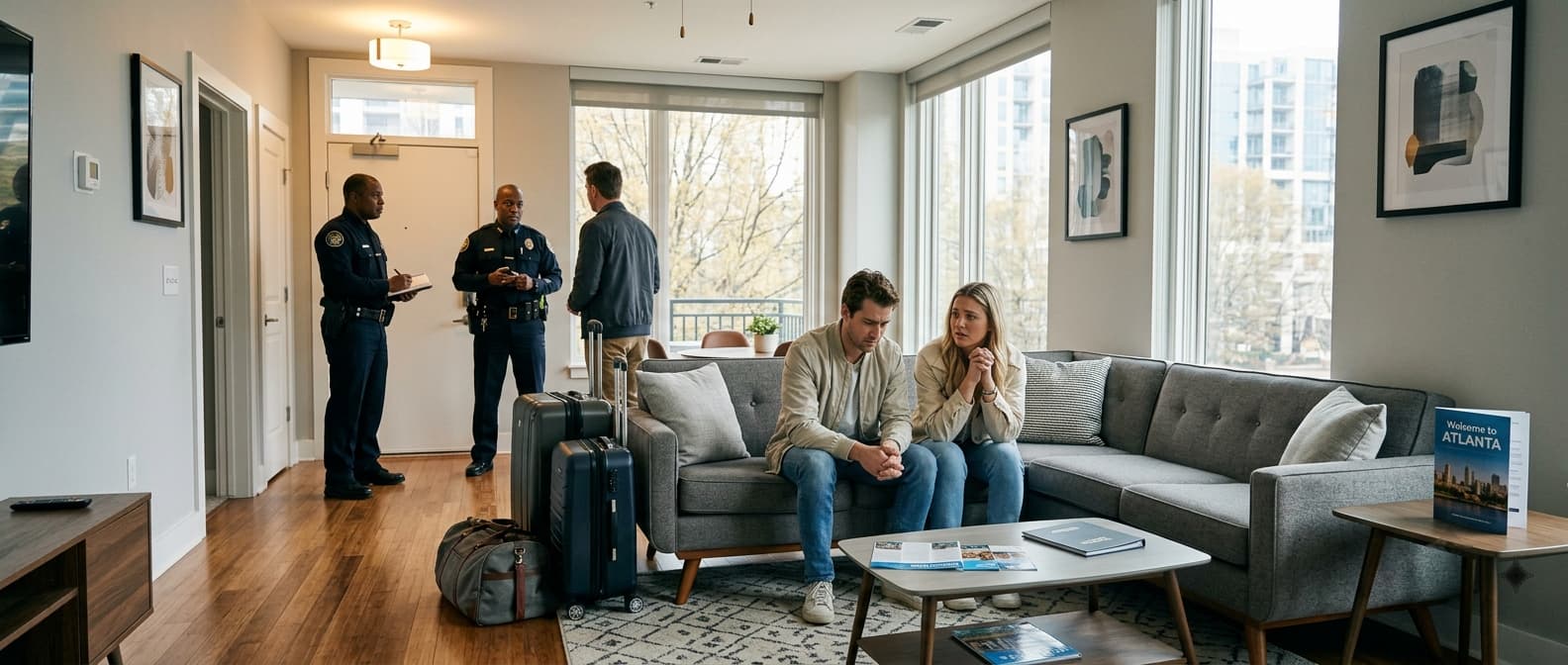
Vacation rentals offer convenience and affordability, but they can also create unexpected legal nightmares. Imagine checking into an Atlanta Airbnb or vacation rental, only to have police discover drugs on the property. Whether you are a guest, a host, or part of a group booking, finding yourself accused of drug possession in a shared space can lead to serious criminal charges in Georgia.
The legal concept of “constructive possession” means you don’t have to physically hold drugs to be charged with possessing them. This creates a serious problem in vacation rentals where multiple people come and go, where previous renters may have left contraband behind, and where hosts may not know what guests bring into their properties. Understanding your rights and the legal standards Georgia courts use to determine accountability is essential if you face drug charges connected to a vacation rental.
Attorney Michael Bixon has aggressively defended clients throughout Atlanta facing drug charges in complex scenarios, including those involving shared spaces, vacation rentals, and situations where ownership and control are disputed. This article explains what happens when drugs are found in an Atlanta vacation rental, who can be held criminally responsible, and how an experienced Atlanta criminal defense attorney can protect your future.
Understanding “Constructive Possession” in a Shared Space
Georgia law recognizes two types of possession: actual possession and constructive possession. Actual possession is straightforward: the drugs are on your person or in your hand. Constructive possession is far more complicated and creates the most problems in vacation rental scenarios.
Under Georgia law, constructive possession means you have control over the location where drugs are found, even if they are not physically on you. According to O.C.G.A. § 16-13-30, it is unlawful to possess controlled substances. But possession requires more than mere presence in a location where drugs exist. Georgia courts have established that the prosecution must prove you had both knowledge of the drugs and the ability to exercise control over them.
In a vacation rental setting, this creates immediate challenges. If police find drugs in a common area such as the living room, kitchen, or bathroom, how do they determine which guest “possessed” them? The answer depends on several factors:
Proximity to the drugs: Were the drugs found in an area you had exclusive access to, like a bedroom you were using, or in a shared space accessible to everyone?
Fingerprints or DNA evidence: Physical evidence linking you to the drugs or the packaging strengthens the prosecution’s case.
Incriminating statements: Anything you say to police officers can be used to establish your knowledge or control of the drugs.
Exclusive access: Did you have a key, code, or exclusive right to enter the area where drugs were found?
Georgia courts have held that merely being present where drugs are found is not sufficient for a conviction. In shared vacation rentals, this legal principle becomes critical. If ten people rented an Airbnb for a weekend and police discover marijuana in the kitchen, the state cannot simply charge everyone with possession. They must prove which specific individual or individuals had knowledge and control.
However, law enforcement often takes an aggressive approach in these situations. Officers may arrest multiple people and let the courts sort out who actually possessed the contraband. This means you can be arrested, booked, and charged even when you had no knowledge that drugs were present. An experienced Atlanta drug defense attorney understands how to challenge constructive possession charges by demonstrating a lack of knowledge, a lack of control, or evidence pointing to someone else’s ownership.
The Shared Rental Dilemma: Who Is Accountable?
Vacation rentals present unique accountability challenges because of their transient nature. Unlike a permanent residence, where law enforcement can more easily establish who controls the property, vacation rentals involve constantly changing occupants, shared access, and limited accountability for what previous renters may have left behind.
When It Belongs to Another Guest or a Previous Renter
One of the most frustrating scenarios occurs when you are charged with possessing drugs that belonged to someone else entirely. Perhaps another guest brought drugs into the rental. Perhaps the previous renter left contraband hidden somewhere. Perhaps even the property owner or cleaning crew unknowingly left something behind.
Georgia law recognizes that constructive possession requires exclusive control or joint control with knowledge. If drugs were found in a shared space and multiple people had access to that space, the prosecution faces a difficult burden of proof. They must show not only that you knew the drugs were there but also that you had the ability to control them. Similar situations occur when drugs are found in vehicles with multiple passengers.
Defense attorneys challenge these charges by:
Demonstrating lack of exclusive access: If everyone staying at the rental had access to the location where drugs were found, the prosecution cannot prove you had greater control than anyone else.
Establishing an alternative explanation: Evidence showing another guest or previous renter likely brought the drugs undermines the prosecution’s case.
Highlighting the transient nature of the rental: Vacation rentals change hands frequently. Without concrete evidence tying you specifically to the drugs, the prosecution’s case weakens.
Challenging police procedures: If officers failed to properly investigate who actually controlled the drugs, a defense attorney can argue that the charges lack sufficient evidentiary support.
For example, if police find cocaine residue in a bathroom shared by four guests, simply arresting all four does not satisfy the legal standard. The prosecution must present evidence showing which specific guest possessed the cocaine. Without fingerprints, admissions, or other concrete evidence, an aggressive criminal defense attorney can argue the state has not met its burden.
The Legal Reality of Group Bookings and Wide Police Sweeps
Group bookings create additional complications. When a large group rents a vacation property for an event, police may conduct what is sometimes called a “wide sweep,” arresting everyone present when drugs are discovered. This frequently happens when neighbors complain about noise, when someone calls 911, or when police respond to another incident and discover contraband.
Georgia law enforcement officers often arrest multiple people in these scenarios, operating under the theory that someone in the group possessed the drugs, and prosecutors can determine who later. This approach violates the fundamental principle that presence alone does not equal possession, but it happens frequently.
If you are arrested as part of a wide sweep at an Atlanta vacation rental, several defenses may apply:
Lack of knowledge: You may not have known drugs were present at the property. Perhaps someone else brought them, or they were already there when you arrived.
No ability to control: Even if you knew drugs existed somewhere in the rental, you may not have had the ability to access or control them. For example, if drugs were locked in another guest’s bedroom, you lacked control.
Illegal search and seizure: Police must have legal authority to search the vacation rental. If officers violated the Fourth Amendment by searching without a warrant or without valid consent, evidence obtained during that search may be suppressed.
Presumption of joint possession is improper: Georgia courts do not permit prosecutors to presume everyone in a location jointly possessed drugs. The state must prove your individual knowledge and control.
In one common scenario, police respond to a noise complaint at an Airbnb. When they arrive, they smell marijuana. They enter the property, find drugs in a common area, and arrest everyone present. An experienced Atlanta criminal defense attorney will examine whether police had legal authority to enter and search the property, whether anyone gave valid consent, and whether the evidence actually connects you personally to the drugs. Challenging these group arrest scenarios requires detailed knowledge of Georgia search and seizure law and constructive possession standards.
Key Differences: Being the Airbnb Host vs. Being a Guest
The legal consequences of drugs being found in a vacation rental differ significantly depending on whether you are the host or the guest. Both face serious potential criminal liability, but the legal theories and defenses vary.
If you are a guest:
As a guest, your liability depends on proving you had knowledge and control over the drugs. You may have a stronger defense if:
- The drugs were found in a common area or another guest’s private space
- You were not the person who booked the rental
- You can demonstrate that you had just arrived and had not been on the property long
- Other guests had equal or greater access to the location where drugs were found
- You can show that the drugs belonged to a previous renter
Georgia prosecutors must prove beyond a reasonable doubt that you knew drugs were present and had the ability to exercise control over them. Your defense attorney will focus on creating reasonable doubt about your knowledge and control.
If you are the host (property owner or manager):
Hosts face a different set of legal risks. Under Georgia law, you can be charged with maintaining a place for drug activity under O.C.G.A. § 16-13-32.2 if prosecutors believe you knowingly allowed your property to be used for drug crimes. This is separate from simple possession charges and carries serious penalties.
However, hosts also have strong defenses:
Lack of knowledge: Simply because a guest brought drugs into your rental does not mean you knew or should have known. Vacation rental hosts are not expected to monitor guests’ every action.
No control over guest behavior: Once guests rent the property, they have temporary exclusive possession. You cannot be held criminally liable for what guests bring into a property you do not control during their rental period.
Good faith rental business: Operating a legitimate vacation rental business is legal. Without evidence that you knowingly facilitated drug activity, prosecutors cannot sustain charges under the maintaining-a-drug-house statute.
The distinction between guest and host is critical. Guests face possession charges based on constructive possession theories. Hosts face possession charges only in rare circumstances where evidence shows they had knowledge and control, but they may face separate charges for maintaining a place for drug use if prosecutors believe they knowingly allowed the property to be used for illegal purposes.
Both guests and hosts should immediately consult an experienced Atlanta drug crimes attorney if they face charges connected to a vacation rental. The legal defenses and strategies differ significantly based on your role.
Steps to Protect Yourself If You Face Accusations at a Vacation Rental
If police discover drugs at an Atlanta vacation rental where you are staying or hosting, the steps you take immediately can significantly impact your case. Many people make critical mistakes in the first hours after arrest that harm their defense.
Do not speak to police without an attorney present.
This is the most important step. Law enforcement officers will ask questions designed to establish your knowledge and control of the drugs. They may say things like, “If you just tell us whose drugs these are, we can clear this up.” Do not believe this. Anything you say can and will be used against you. Even seemingly innocent statements like “I’ve been here since Friday” or “I share that bedroom with my friend” can be used to prove you had access to and control over the location where drugs were found.
Exercise your Fifth Amendment right to remain silent. Clearly state, “I am invoking my right to remain silent and want to speak to an attorney.” Then stop talking.
Do not consent to searches.
Police may ask for permission to search your belongings, your car, or other areas of the vacation rental. You have the constitutional right to refuse. If officers have a warrant, they will search regardless of your consent. If they do not have a warrant and you refuse consent, they must establish probable cause or another legal justification to search. Consenting to a search waives your Fourth Amendment rights and can give police access to evidence they otherwise could not legally obtain.
Document everything you can remember.
As soon as possible, write down everything you remember about your time at the vacation rental:
- When you arrived
- Who else was present
- What areas of the property did you access
- Whether you saw drugs or suspected drug activity
- What officers said and did
- Whether anyone gave consent to search
These details may become critical to your defense. Memories fade quickly, so documenting everything while it is fresh helps your attorney build the strongest possible case.
Preserve evidence of your rental agreement and communications.
Save all emails, text messages, and booking confirmations related to the vacation rental. This evidence can show:
- You were not the primary renter (which may reduce your apparent control over the property)
- You had just arrived (reducing the time you could have known about drugs)
- You raised concerns about other guests (suggesting you did not participate in or condone drug activity)
Contact an experienced Atlanta drug defense attorney immediately.
Time is critical in drug cases. An attorney can:
- Advise you on how to respond to police questioning
- Investigate the facts while evidence and witnesses are available
- Challenge the legality of searches and seizures
- File motions to suppress illegally obtained evidence
- Negotiate with prosecutors before formal charges are filed
- Build a comprehensive defense strategy
Attorney Michael Bixon has successfully defended clients facing drug charges in Atlanta’s courts for years. His experience with Georgia’s drug laws, constructive possession defenses, and Fourth Amendment protections provides clients with aggressive representation when their freedom is at stake.
Understand the potential penalties.
Georgia’s drug penalties vary depending on the type and amount of drugs involved. Marijuana possession of less than one ounce is a misdemeanor carrying up to 12 months in jail and a $1,000 fine. Possession of cocaine, methamphetamine, or other controlled substances is a felony carrying 1 to 15 years in prison for a first offense, with penalties increasing for larger amounts.
Beyond the criminal penalties, a drug conviction can impact:
- Your employment and professional licenses
- Your ability to obtain housing
- Your eligibility for student financial aid
- Your immigration status if you are not a U.S. citizen
- Your driving privileges
- Your right to possess firearms
Understanding the full scope of what you are facing helps you appreciate why aggressive legal defense is essential.
How an Atlanta Drug Defense Attorney Protects Your Future
Facing drug charges stemming from a vacation rental requires experienced legal representation. These cases involve complex legal issues regarding constructive possession, shared spaces, Fourth Amendment protections, and challenging the prosecution’s evidence.
Challenging constructive possession.
An experienced Atlanta drug defense attorney will scrutinize the prosecution’s evidence to challenge whether they can prove you had knowledge and control over the drugs. This includes:
- Demonstrating that you had no exclusive access to where drugs were found
- Showing that other individuals had equal or greater access
- Presenting evidence that the drugs belonged to another guest or previous renter
- Highlighting the lack of fingerprints, DNA, or other physical evidence connecting you to the drugs
- Using witness testimony to establish that you did not know drugs were present
Georgia courts require the prosecution to prove possession beyond a reasonable doubt. Creating reasonable doubt about your knowledge or control can result in charges being dismissed or a not-guilty verdict.
Suppressing illegally obtained evidence.
The Fourth Amendment protects you against unreasonable searches and seizures. If police searched the vacation rental without a warrant, without valid consent, or beyond the scope of any exception to the warrant requirement, your attorney can file a motion to suppress the evidence.
Common Fourth Amendment violations in vacation rental drug cases include:
- Searching without a warrant and without a valid exception
- Exceeding the scope of consent given by a host or guest
- Conducting a search based on invalid probable cause
- Entering the property without legal authority
- Searching areas beyond what a warrant authorized
If a court grants a motion to suppress, the illegally obtained evidence cannot be used against you. In many cases, this results in the prosecution dismissing charges because they lack sufficient evidence to proceed.
Negotiating with prosecutors.
Not every case goes to trial. An experienced attorney can negotiate with prosecutors to:
- Reduce felony charges to misdemeanors
- Secure pretrial diversion programs that avoid a conviction
- Negotiate plea agreements with reduced sentences
- Obtain conditional discharge for first-time offenders
Attorney Michael Bixon’s experience with Atlanta-area prosecutors and courts allows him to identify when negotiation is beneficial and when taking a case to trial is the better strategy.
Preparing for trial.
If your case goes to trial, your attorney will:
- Cross-examine law enforcement officers about the basis for the search and arrest
- Challenge the reliability of the prosecution’s evidence
- Present expert testimony on constructive possession standards
- Call witnesses who can testify that you lacked knowledge or control
- Argue that the prosecution has not met its burden of proof
Georgia juries decide whether the prosecution has proven guilt beyond a reasonable doubt. An experienced trial attorney knows how to present a compelling defense that creates reasonable doubt in jurors’ minds.
Protecting your future.
Beyond fighting the immediate charges, a criminal defense attorney focuses on minimizing the long-term impact on your life. This includes:
- Seeking outcomes that avoid a permanent criminal record
- Protecting your professional licenses and employment
- Addressing immigration consequences for non-citizens
- Preserving your driving privileges
- Ensuring you understand all collateral consequences of any resolution
Drug charges connected to vacation rentals are defensible. With the right legal strategy, many clients achieve favorable outcomes, including dismissed charges, not-guilty verdicts, or reduced penalties that allow them to move forward without a felony conviction.
If you face drug charges related to an Atlanta Airbnb or vacation rental, contact an experienced Atlanta drug defense attorney immediately. Attorney Michael Bixon provides aggressive, client-focused representation for individuals facing drug charges throughout the Atlanta area. Your future is too important to leave to chance.