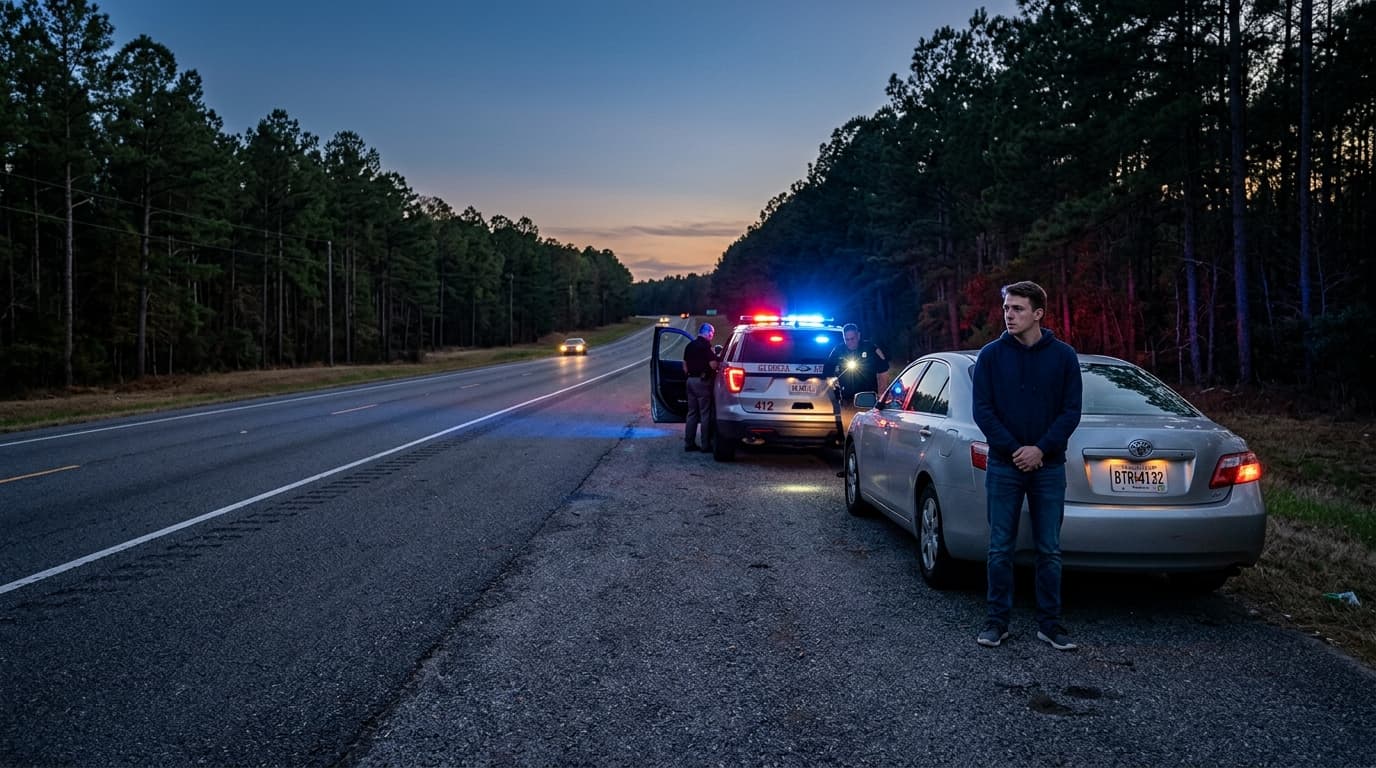
Getting pulled over is stressful enough. But when police find drugs in a car you’re riding in, and you had no idea they were there, the consequences can be devastating. In Georgia, you absolutely can be arrested and charged with drug possession even when the drugs belong to someone else. Understanding how Georgia law works in multi-passenger drug cases could mean the difference between a felony conviction and walking away free.
Michael Bixon is a criminal defense attorney who has spent years defending clients in Atlanta facing drug possession charges. He’s seen too many passengers arrested for contraband they didn’t own, didn’t know about, and never touched. This article explains how Georgia prosecutors charge innocent passengers, what legal defenses apply, and what you must do at the scene to protect yourself.
The Scenario of Multiple Arrests for Contraband Found in a Shared Vehicle
Here’s how it typically happens: Four friends are driving through Atlanta when police pull them over for a minor traffic violation. The officer claims to smell marijuana. He orders everyone out of the vehicle and conducts a search. Under the rear passenger seat, officers find a bag containing cocaine and pills.
No one admits ownership. Within minutes, all four occupants are arrested and charged with felony drug possession under O.C.G.A. § 16-13-30.
This is not a rare occurrence. Georgia law enforcement agencies routinely arrest every person in a vehicle when drugs are found, and no one claims them. The legal theory? Constructive possession. The practical reality? You can face years in prison for drugs that weren’t yours, even if you were just getting a ride home from work.
The prosecution’s strategy is simple: arrest everyone, let them fight it out in court, and hope someone pleads guilty or that circumstantial evidence convinces a jury. For passengers, this means immediate arrest, a mugshot, jail time until bond is posted, and the financial and emotional burden of defending against serious felony charges.
Michael Bixon has defended countless passengers in these exact situations. His approach is aggressive: challenge the search, attack the state’s evidence, and force prosecutors to prove beyond a reasonable doubt that you, not someone else, actually possessed those drugs.
Actual Possession vs. Constructive Possession: The Legal Definition of “Power and Intent to Control”
Georgia law recognizes two types of drug possession: actual possession and constructive possession.
Actual possession is straightforward. If drugs are in your pocket, in your hand, or physically on your person, you have actual possession. These cases are harder to defend because the drugs are literally on you.
Constructive possession is where passenger cases become complicated. Under Georgia law, you can be convicted of possessing drugs even if you never touched them. The state must prove two elements:
- You had the power to control the drugs (you could access them)
- You intended to control the drugs (you knew they were there and planned to exercise control)
This definition comes from Georgia case law and has been applied in thousands of drug prosecutions. The critical word is “and”; prosecutors must prove both elements beyond a reasonable doubt.
Where were the drugs found? This matters enormously. Drugs in the center console are accessible to everyone. Drugs under the driver’s seat are closer to the driver. Drugs in a passenger’s purse or backpack create a stronger case against that specific person.
But proximity alone is not enough. Georgia courts have consistently ruled that “mere presence” in a vehicle where drugs are found does not prove constructive possession. The state needs additional evidence showing you knew about the drugs and intended to control them.
In practice, however, overzealous prosecutors and police ignore this requirement. They arrest first and sort out the evidence later, leaving innocent passengers to hire attorneys and fight charges that never should have been filed.
The “Equal Access” Rule in Georgia: Using Established State Case Law to Fight Multi-Passenger Drug Charges
The equal access rule is one of the most powerful defenses in Georgia drug cases involving multiple occupants. This legal doctrine states that when two or more people have equal access to the location where drugs are found, the state cannot prove beyond a reasonable doubt that any specific person possessed them unless there is additional evidence tying one person to the drugs.
Georgia appellate courts have applied this rule repeatedly. In cases where drugs were found in a shared area of a vehicle and all passengers had equal access, convictions have been reversed because the state failed to prove who actually possessed the contraband.
For example, if cocaine is found in the glove compartment and both the driver and front passenger could access it, the state must present evidence beyond just location. Did one person make a furtive movement toward the glove box? Were there fingerprints? Did someone make incriminating statements? Without this additional evidence, the equal access rule creates reasonable doubt.
Michael Bixon uses the equal access rule aggressively in passenger defense cases. When the state’s evidence consists only of “you were in the car,” that’s not enough. The prosecution must prove you specifically had the power and intent to control those drugs, not just that you were present.
This defense is particularly effective when:
- Drugs are found in a common area (center console, under a seat accessible to multiple people)
- No one admits ownership
- There are no fingerprints or DNA linking you to the drugs
- You were not the owner or primary driver of the vehicle
- Other occupants had equal or greater access to the location
Courts have recognized that it would be fundamentally unfair to convict someone simply because they accepted a ride or were in the wrong place at the wrong time. The state bears the burden of proof, and if it cannot prove you, as opposed to someone else, possessed the drugs, the charges must be dismissed or result in an acquittal.
What to Do at the Scene: Exercising the Right to Remain Silent and Refusing Voluntary Searches of Personal Items
The moments following a traffic stop can determine the outcome of your case. What you say and do matters enormously. Here’s what Michael Bixon tells every client: exercise your constitutional rights immediately and without apology.
Remain Silent
You have the absolute right to remain silent under the Fifth Amendment. Use it. Police will ask questions designed to build a case against you:
- “Whose car is this?”
- “Do you know what’s in the car?”
- “Did you see anyone put anything under the seat?”
- “Have you used drugs today?”
Do not answer. Politely say, “I’m exercising my right to remain silent, and I want to speak with my attorney.” Repeat this as many times as necessary. Police may pressure you, suggest that “innocent people cooperate,” or claim that silence makes you look guilty. Ignore them. Silence cannot be used against you in court, but your words absolutely can be.
Refuse Voluntary Searches of Personal Items
If you have a backpack, purse, phone, or any personal item, police need your consent or probable cause to search it. If an officer asks, “Can I look in your bag?” the correct answer is: “I do not consent to any searches.”
This is not an admission of guilt. It is you exercising your Fourth Amendment rights. If police have probable cause, they will search anyway, but your refusal preserves your ability to challenge that search in court later.
Many passengers make the fatal mistake of thinking, “I have nothing to hide, so I’ll just let them search.” Then, the police find something that wasn’t yours, drugs someone else stashed in your bag without your knowledge, and you’re arrested. Once you give consent, you cannot challenge the search.
Do Not Make Statements About Ownership
If drugs are found in the vehicle, police will pressure everyone to “tell the truth” about whose drugs they are. Do not make any statements. Do not speculate. Do not try to help the police sort it out. Say nothing.
Even seemingly innocent statements can be twisted. “I don’t know anything about that” can later be argued as a false exculpatory statement (you claimed ignorance, so you must have known something). “Those must be [driver’s name]’s” can be used against the driver and won’t help you.
The only statement you should make is: “I want to speak with my attorney.”
Document Everything You Can
If possible, and if safe to do so, mentally note:
- Where exactly were the drugs found
- Who was sitting where
- What the officer said and did
- Whether the search seemed legal
After you are released or post bond, write down everything you remember. These details are critical for your defense attorney.
The Risk of Circumstantial Evidence: How Prosecutors Try to Prove Knowledge Based on Proximity or Nervous Behavior
Even when the state lacks direct evidence, prosecutors will build a circumstantial case against you. Understanding their tactics helps you and your attorney dismantle their arguments.
Proximity as “Evidence”
Prosecutors love to argue: “The defendant was sitting right next to where the drugs were found, so he must have known they were there.” This is weak reasoning, but juries sometimes buy it.
Your defense attorney will counter that proximity proves nothing. Millions of people ride in cars every day without knowing everything inside the vehicle. You don’t inspect under seats, inside glove boxes, or in the trunk before accepting a ride. Proximity is not knowledge.
Nervous Behavior
Police reports often describe passengers as “nervous,” “fidgety,” or “avoiding eye contact.” Prosecutors use this to suggest consciousness of guilt.
The reality? Being pulled over is stressful for everyone. Seeing police search a vehicle and find drugs is terrifying, even if you’re innocent. Nervousness is a normal human reaction to police encounters, not evidence of drug possession.
Defense attorneys challenge these characterizations by pointing out that the officer’s subjective interpretation of your demeanor is not evidence. Nervousness does not equal guilt.
Furtive Movements
Police may claim they saw you “reach toward” or “make a furtive movement” near where drugs were later found. This is often exaggerated or fabricated to justify a search or build a case.
Your attorney will scrutinize the officer’s report and any video footage (dashcam, body cam) to determine whether these claimed movements actually occurred and whether they prove anything. Often, they don’t.
Text Messages or Phone Evidence
If police search your phone (with or without a warrant), they may look for text messages referencing drugs. Even ambiguous messages can be misinterpreted.
If you refused consent to search your phone, your attorney can challenge whether police had legal authority to access it. If they did search it, your attorney will examine whether any messages actually prove you knew about or possessed the drugs in question.
Association with the Owner
Prosecutors will argue guilt by association: “You were riding with a known drug dealer, so you must have known there were drugs in the car.”
This argument fails logically and legally. You are not responsible for someone else’s criminal history or behavior. Even if you knew the driver had prior drug charges, that doesn’t prove you knew about drugs in the car on this specific occasion.
The key point: circumstantial evidence must be strong enough to exclude every reasonable hypothesis except guilt. In multi-passenger drug cases, there are often multiple reasonable explanations (someone else’s drugs, you didn’t know, you were just a passenger). A skilled defense attorney will highlight these alternative explanations and create reasonable doubt.
How Defense Counsel Isolates Your Case: Aggressively Moving to Separate Your Liability from the True Owner
When Michael Bixon represents a passenger facing drug possession charges, his strategy focuses on one goal: separating you from the actual offender and demolishing the state’s case against you specifically.
Challenging the Traffic Stop and Search
The first step is examining whether the police had legal grounds to stop the vehicle and search it. If the stop was pretextual or the search violated the Fourth Amendment, all evidence from that search may be suppressed.
Michael Bixon files motions to suppress evidence when:
- The traffic stop lacked reasonable suspicion or probable cause
- Police extended the stop beyond its lawful scope
- The search exceeded the bounds of consent or legal justification
- Police violated knock-and-announce rules or other procedural requirements
If the drugs are suppressed, the case is over.
Using the Equal Access Rule
As discussed earlier, the equal access rule is powerful in multi-passenger cases. Your attorney will file motions and present an argument showing that multiple people had access to where the drugs were found, and the state cannot prove that you, as opposed to someone else, possessed them.
Highlighting Lack of Direct Evidence
Defense counsel will force prosecutors to admit what they don’t have:
- No fingerprints on the drug packaging linking you to the drugs
- No DNA evidence
- No confession or admission
- No drugs found on your person
- No drug paraphernalia in your possession
- No eye-witness testimony that you put the drugs there
This is often enough to create reasonable doubt.
Presenting Exculpatory Evidence
Your attorney may present evidence showing:
- You were a passenger, not the owner or driver
- You did not have control over the vehicle
- You had no knowledge of the drugs
- The drugs were found in an area you did not access
- You cooperated fully and exercised your rights appropriately
Seeking Dismissal Pre-Trial
In many cases, a strong motion to dismiss based on insufficient evidence can end the case before trial. If the state cannot prove constructive possession, the case should not proceed.
Negotiating Strategically
If the case does not get dismissed, an experienced attorney will negotiate from a position of strength. Prosecutors know when their case is weak. They may offer reduced charges or diversion programs rather than risk losing at trial.
Going to Trial When Necessary
Michael Bixon is not afraid to take cases to trial. When the state’s evidence is weak and the client is innocent, a trial is often the best option. A jury instruction on reasonable doubt, combined with effective cross-examination of the arresting officer and a closing argument highlighting the lack of evidence, can result in a not-guilty verdict.
The defense strategy is tailored to your specific case, but the overarching goal is always the same: force the state to prove its case beyond a reasonable doubt, and when they can’t, secure your freedom.
Contacting Bixon Law for a Free Consultation
Being arrested for someone else’s drugs is a nightmare, but it doesn’t have to end in a conviction. Georgia law requires prosecutors to prove you actually possessed the drugs, not just that you were in the wrong place at the wrong time. With the right legal defense, these charges can be beaten.
Michael Bixon has built his practice on aggressive criminal defense in Atlanta. He understands how drug possession cases are prosecuted in Fulton County, DeKalb County, Cobb County, and throughout the metro Atlanta area. He knows the prosecutors, the judges, and the legal strategies that work.
If you’ve been charged with drug possession as a passenger, time is critical. Evidence must be preserved, witnesses interviewed, and legal motions filed quickly. Waiting can hurt your case.
Bixon Law offers free consultations. Call anytime, day or night. Michael Bixon will review your case, explain your options, and fight aggressively to protect your freedom and your future.
Don’t let someone else’s drugs ruin your life. Contact Bixon Law today.